From Organic Growth to Intentional Flow: How Alfa Financial Software Increased Alignment and Shortened Time-to-Value Using Team Topologies
Author: Grahame Williams, Associate Director: Engineering & Sustainability at Alfa Financial Software

Key takeaways
Alfa has seen multiple benefits from the changes introduced by the ADM:
Improved clarity of ownership: it’s now much clearer who is responsible for what throughout the development process. Feedback from Delivery and other colleagues indicates that the challenge of “who are we meant to collaborate with?” has been addressed.
Reduced cognitive load: teams now have more coherent areas of responsibility and, in theory, fewer unrelated demands, making their work more sustainable and improving their ability to think and work in a genuinely product-oriented manner.
Faster flow of work: changes move more smoothly through the development process, supported by the clearer interaction modes and more intentional communication.
Improved organizational alignment: Alfa’s product engineering structure now reflects how customers think about their business, which improves overall understanding and cohesion. This enables us to set coherent longer-term product direction while remaining flexible enough to adapt as necessary.
Alfa Financial Software is a global, medium-sized company with a long-standing reputation for successfully delivering enterprise software to the asset finance industry. Asset finance covers the financing of everything from cars to agricultural equipment, from medical kits to servers, even satellites. The company's class-leading SaaS platform, Alfa Systems, operates in 37 countries across five continents, serving large, complex enterprises, as well as smaller finance providers. Our customers include major organisations such as Santander, Mercedes-Benz Financial Services, John Deere Financial Services, Standard Bank and Siemens Financial Services. Five of the top twenty European asset finance providers are Alfa customers, and three of the top five US auto lenders are Alfa customers.
Alfa is proud of its vibrant culture, rooted in collaboration, mutual support, and a strong shared purpose. However, recent growth and scaling brought strain from delivering complex software within a largely organically developed product engineering structure.
To address these challenges, Alfa launched a new initiative, the Alfa Development Model, designed to enable teams to work in a more flow-oriented manner. This approach involved implementing key ideas from Team Topologies alongside complementary changes: reshaping team responsibilities, introducing intentional interaction patterns, and designing an organizational structure to optimize flow and responsiveness, reduce cognitive load, and shape the future architecture of the core product.
While challenges were encountered, the ADM enabled Alfa to work and evolve in a way that supports long-term, sustainable delivery and reflects its values.
Operating in a complex enterprise environment
Alfa employs over 550 people globally, with around 150 people in our EMEA-based product engineering group. The company operates in complex domains and heavily regulated industries, developing and delivering enterprise software. Approximately 25 product engineering teams contribute to strategic investment work and collaborate with delivery and client teams, all aiming to be product-led and focused on our core software product, Alfa Systems.
The significant growth we experienced over the past few years increased organizational complexity, leading to challenges around team boundaries, unclear ownership in certain areas, and unnecessary communication overhead. Together, these factors affected our ability to deliver at pace and respond as quickly.
Collaborate, but with who?
As our organization scaled, communication bottlenecks began to emerge and teams often struggled to identify the right people to collaborate with. “Knowing who to collaborate with, that’s the big rock,” one Delivery colleague summarized. Informal networks and intermediaries were often used to navigate team structures, slowing down progress and inevitably causing frustration.
In addition to communication bottlenecks, cognitive load on teams was significant. Many teams were responsible for collections of unrelated domains in the product, posing challenges to the product-oriented thinking they desired. The ambiguity and breadth of responsibility impacted the overall flow of value to customers, leading to certain teams becoming “booked up” for months in advance. Alfa determined that it needed to address team structure, roles, interaction modes and ownership to become more genuinely product-oriented and more responsive.
Defining the Future: Goals of our Alfa Development Model (ADM)
The primary goal of the ADM was to improve the flow of value throughout the development process, aiming to make collaboration smoother, clearer, and more sustainable. The initiative avoided branding itself as an “agile transformation”, as many agile practices were already in place. Instead, the focus was deeper: building a model that would reduce cognitive load, foster autonomy and ownership, and align our teams more clearly with our product and business needs.
Implementing our ADM: A Phased, Flow-Oriented Approach
Discovery and Planning
I’m not sure how we first came across Team Topologies but I do very clearly remember reading the book while sitting at a tiny makeshift desk in the corner of my bedroom in Peckham during the first summer of the pandemic, thinking there could be something very powerful and relevant to Alfa. I was working on a different project at the time, but one that was very much related to challenges of team boundaries, cognitive load and effective ways for teams to work together.
When work on the ADM began, I was sure that the Team Topologies ideas should be foundational to anything we wanted to do. Alfa started by focusing on flow as a central concept that resonated across technical and non-technical parts of the business, conducting workshops to determine main pain points.
Initial Implementation
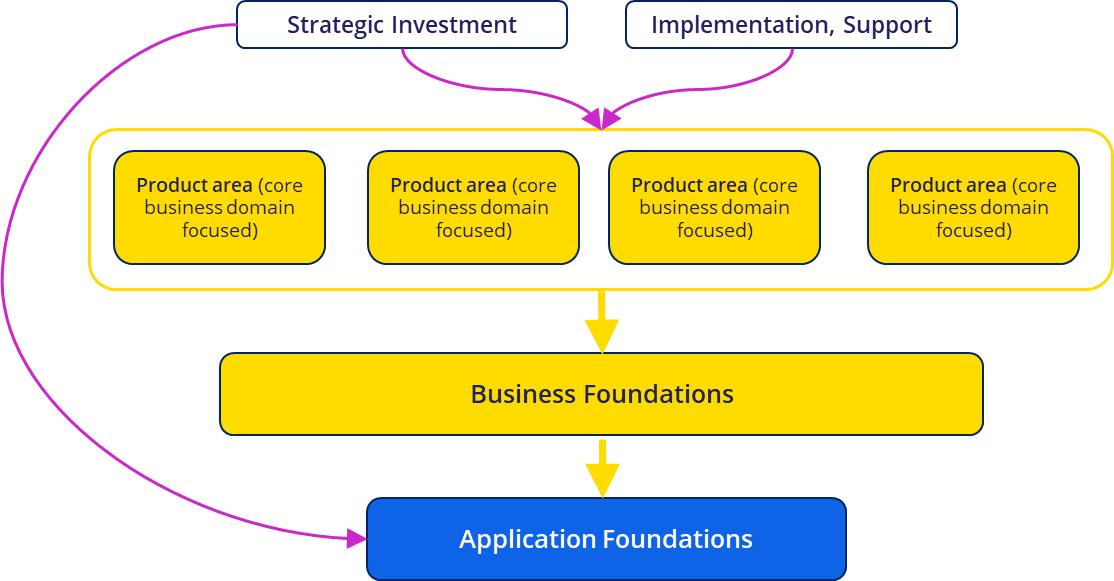
As a first step, in April 2023 a new group called Application Foundations was formed. This group consolidated platform teams (such as Front-End Engineering, Build & Release, and Data Engineering) that had previously been spread across the engineering organisation. This created a clearer separation of responsibilities and served as a starting point for incremental organisational change, allowing Alfa to introduce key concepts gradually.
Key Team Topologies ideas were then introduced more widely through team presentations and a structured program of learning and development sessions focusing on what would become the enabling, platform, and stream-aligned teams. This training covered interactive sessions on team types, cognitive load, and interaction modes.
Restructuring to Stream-Aligned Teams
Following a period of discussion and consultation, in October 2023, the broader engineering group was restructured into product areas aligned with core business domains, effectively making most teams stream-aligned. This restructuring was grounded in how our customers understand their businesses and view Alfa's product, clarifying team boundaries and reducing cognitive load.
This was a high-impact change involving new roles, changes to reporting lines, and significant numbers of people moving to new areas or new teams. We took a phased approach as follows:
Phase 1 (October 2023): The majority of teams and people were aligned with new product areas and roles. Formal training was provided on Team Topologies (team types, interaction modes, Team APIs, flow), holistic product area working and thinking, and general ways of working.
Phase 2 (November 2023): Remaining teams were aligned to product areas, and additional training requested by teams was delivered.
Phase 3 (December 2023): Further requested training was delivered. Pipelines, work backlogs, and reporting transitioned to being managed by the product area rather than by competency, with work routed via the product area.
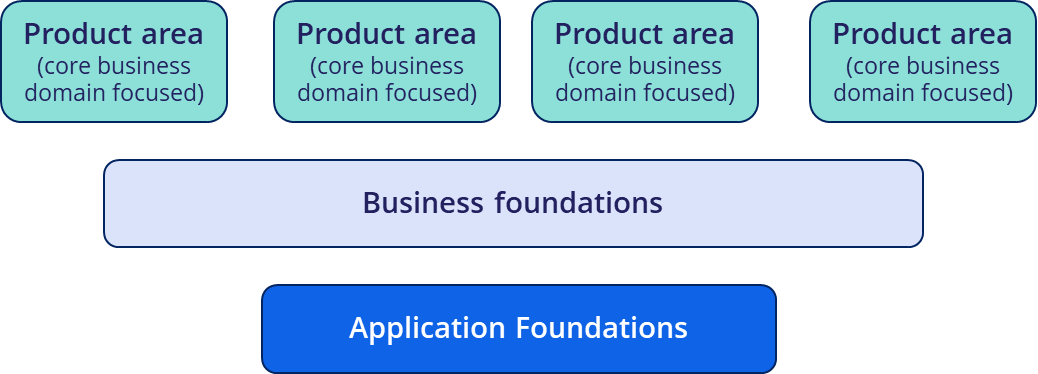
With the overall structure in place, we were also able to define how we wanted work to flow through our engineering organization (over and above the left-to-right flow of value for our stream-aligned teams). We were clear that we wanted people to think functional context first, ensuring, for example, that not every error message with the term “UI” in it is automatically something that should be directed to our Front-end Engineering team within Application Foundations. Context matters.
In addition to the above, we used interaction modes to define expected team-to-team behaviors and published an internal Interaction Modes Quick Reference to encourage consistent interaction practices and avoid people reaching for “collaboration” as the default interaction mode.
Refinement and Expansion
As the new model was implemented, we made a point of iterating and being clear that we wouldn’t always get things right, and that people needed to support each other through the change.
We continue to support changes with further training and discussion and encourage teams to adjust and improve their boundaries over time. We have also bolstered communities of practice and peer networks for engineers, architects, and team leads to help spread learning and refine ways of working.
Outcomes and Impact
We ran a survey for our engineering colleagues roughly six months into the change to find out how the things were bedding in. Key overall themes included:
Our Product Engineering organisational structure is easy to understand and reflects the product well.
Our product areas are now cohesive and provide an opportunity to build real expertise and ownership over broad areas of the product.
Challenges highlighted in survey responses included the risk of siloing mentioned above, and ensuring teams are effectively supported in sharing their learnings across the engineering organisation.
The principle of flow is also informing improvements outside engineering at Alfa, from onboarding to performance reviews, reflecting the wider potential of flow-focused thinking.
To finish, our Delivery colleague in the US who gave us our early “knowing who to collaborate with, that’s the big rock” view, reflects that we’ve seen a huge improvement:
“It's great seeing how much happier the clients are knowing that there are Alfa engineering experts that they can work directly with, rather than a mysterious development black box. Finding the right collaborators used to be the hardest part of our job. Now it’s the best part.”
Next steps: applying Team Topologies at scale
Request a keynote talk to inspire your teams and kickstart a transformation initiative
Order 50 or more copies Team Topologies Second Edition now in bulk - with free worldwide shipping
Buy an Enterprise Content License with access to a huge library of official Team Topologies workshop and training materials to catalyse large-scale transformation
Get an online consultation on Team Topologies with one of the co-authors of the book