Yassir: Transforming a Super App with Team Topologies
Author: Ismail Chaib, Fractional CxO | Investor | former Head of Product & Technology @ Yassir
Reviewed by Manuel Pais, co-author of Team Topologies.
The Challenge: Scaling a Super App in the Maghreb Region
Yassir, the leading super app in the Maghreb region, faced the daunting challenge of scaling its organization to match its explosive business growth. Beginning in 2017 as Algeria’s pioneering ride-hailing app, the company quickly expanded into food delivery by 2019 and then embarked on an ambitious journey to create a unified “Super App” (adding financial services for digital payments) following a $30 million Series A funding round in 2021.
With 8 million customers and a marketplace of over 150,000 commercial partners across 45 cities in Algeria, Morocco, and Tunisia (and recent expansions into Sub-Saharan Africa), Yassir needed organizational structures that could support its rapid expansion and diversification of services.
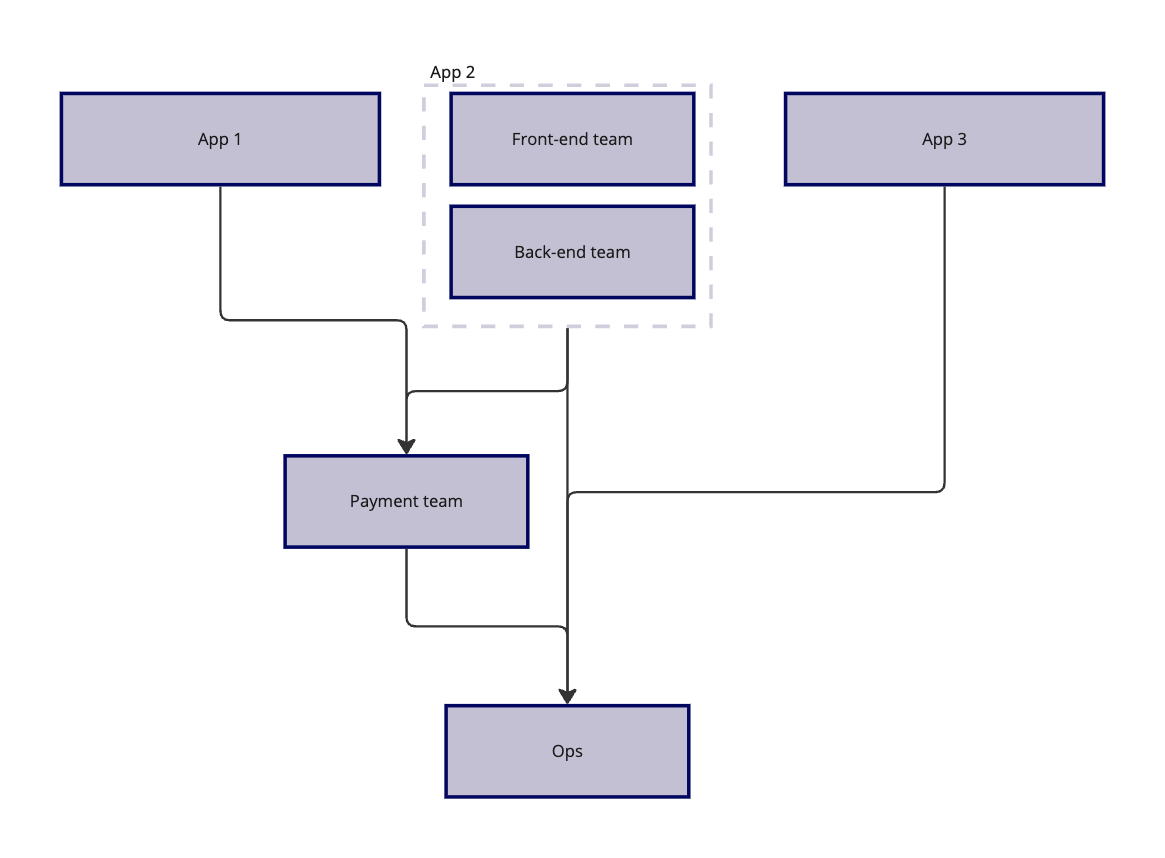
The existing organizational structure proved insufficient for this new phase of growth. With approximately fifty engineers organized into eight teams, an initial audit highlighted four critical issues:
Communication bottlenecks: Teams working in silos created coordination challenges, with even simple feature releases requiring multiple team involvement.
Unclear ownership: Teams organized around projects and historical leaders led to overlapping responsibilities.
Misaligned goals: Teams often had conflicting objectives, delivering outputs that didn't always align with business priorities.
Declining team morale: Engineers felt disempowered, and turnover rates began to rise.
“As we scaled, our teams were struggling to collaborate effectively,” explains a Yassir engineering leader. “Our previous structure might have worked when we had a single app and small team, but it became a significant liability as we grew and diversified our offerings.”
Objectives: Creating a Resilient and Scalable Organization
Yassir embarked on a transformation journey with organizational design as a critical lever for success. Their primary objectives included:
Improving delivery speed: Reducing cycle time from months to weeks.
Enhancing service reliability: Decreasing incidents and mean time to recovery.
Scaling the engineering organization: Growing from 50 to 400+ engineers while maintaining productivity.
Boosting team morale: Creating an environment where engineers felt empowered and engaged.
The company recognized that adopting Team Topologies principles could help address these challenges by providing:
Clear team structures aligned to business domains.
Reduced cognitive load through purposeful team design.
A common language for organizational design discussions.
Patterns for effective inter-team collaboration.
The Transformation: Introducing Team Topologies at Yassir
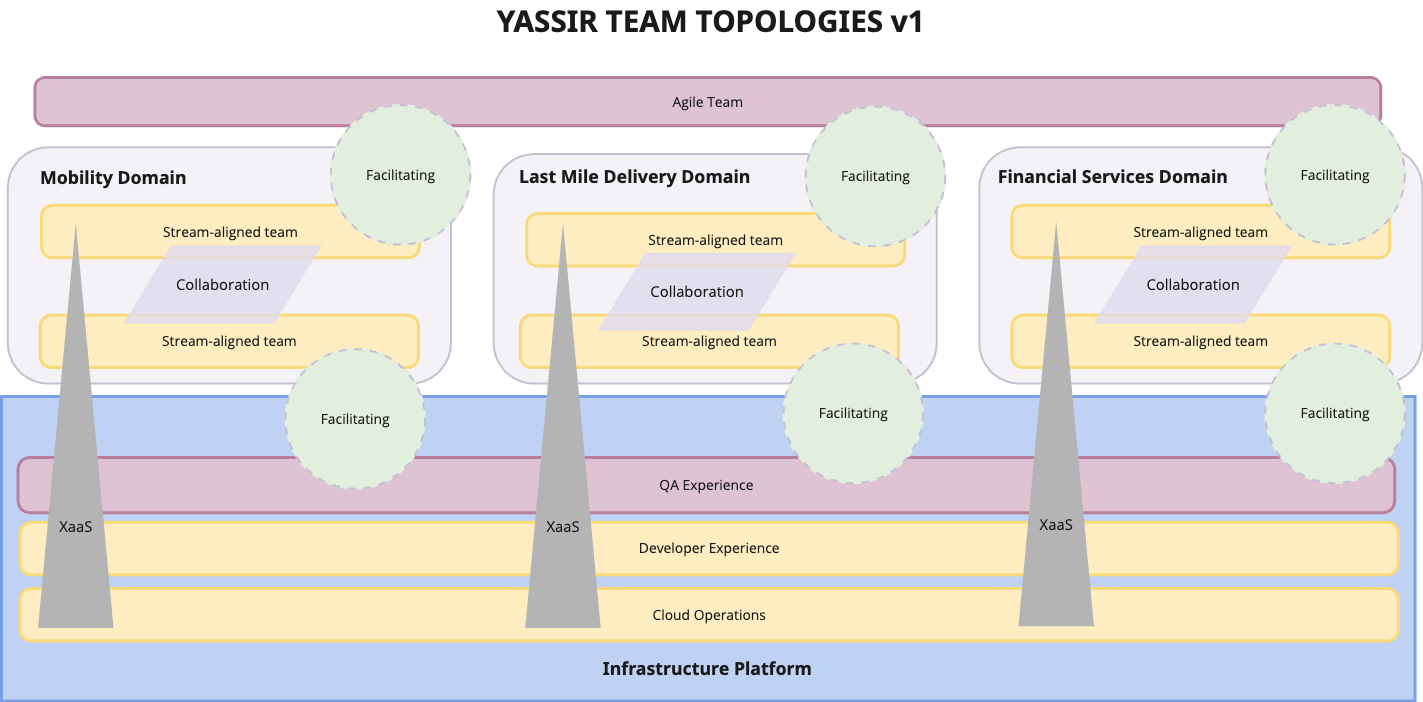
Yassir introduced three fundamental layers of change based on Team Topologies principles:
1. Aligning Teams to Value Streams
The first major shift involved restructuring teams around specific business domains and customer personas (as an example, the mobility domain now includes a customer experience team as well as a driver experience team) rather than technical specializations. This transition away from siloed back-end and front-end teams toward a stream-aligned team structure was guided by principles Yassir called “SAUCE”:
Small: Reducing team sizes from up to twenty people to an average of nine people.
AUdience focused: Designing each team for a specific customer persona.
Cross-functional: Structuring teams to include all skills necessary to deliver value independently, eliminating dependencies on other teams where possible.
Enabled: Empowering teams to own their scope and make decisions with minimal external constraints. Each team has OKRs tracked and reviewed every four months.
“These principles were codified into a policy for team creation,” notes a Yassir organizational leader. “This provided managers with a structured approach when establishing new teams which balances scaling efficiently and maintaining a cohesive, collaborative culture across teams.”
2. Establishing a Platform Team
Yassir centralized infrastructure management and developer experience, enabling other teams to access infrastructure as a self-service. This platform team approach reduced cognitive load on stream-aligned teams, allowing them to focus on delivering customer value rather than managing infrastructure complexities.
3. Introducing Enabling Teams
[FP]The company formed an Agile Coaching team to guide others in embedding agility and embracing new ways of working, operating as an enabling team. One of the most challenging aspects was implementing the facilitating interaction mode due to pushback from some teams with high ownership. However, significant education efforts helped ensure successful adoption.
These structural changes helped Yassir slash cycle time, reduce cognitive load, empower greater autonomy, and foster healthier inter-team relationships. Importantly, Team Topologies provided a shared vocabulary to articulate both pain points and possibilities.
BEFORE
AFTER
Evolution: Adapting to Super App Complexities
As Yassir experienced exponential growth, new complexities emerged. The Super App, a mobile platform (and team) designed to deliver an integrated customer experience across multiple distinct services, required pulling updates from more than ten teams every two weeks. This made delivery unpredictable and painful at times. Coordinating across teams with distinct objectives proved challenging, ownership became fuzzy, and synchronization issues led to delays.
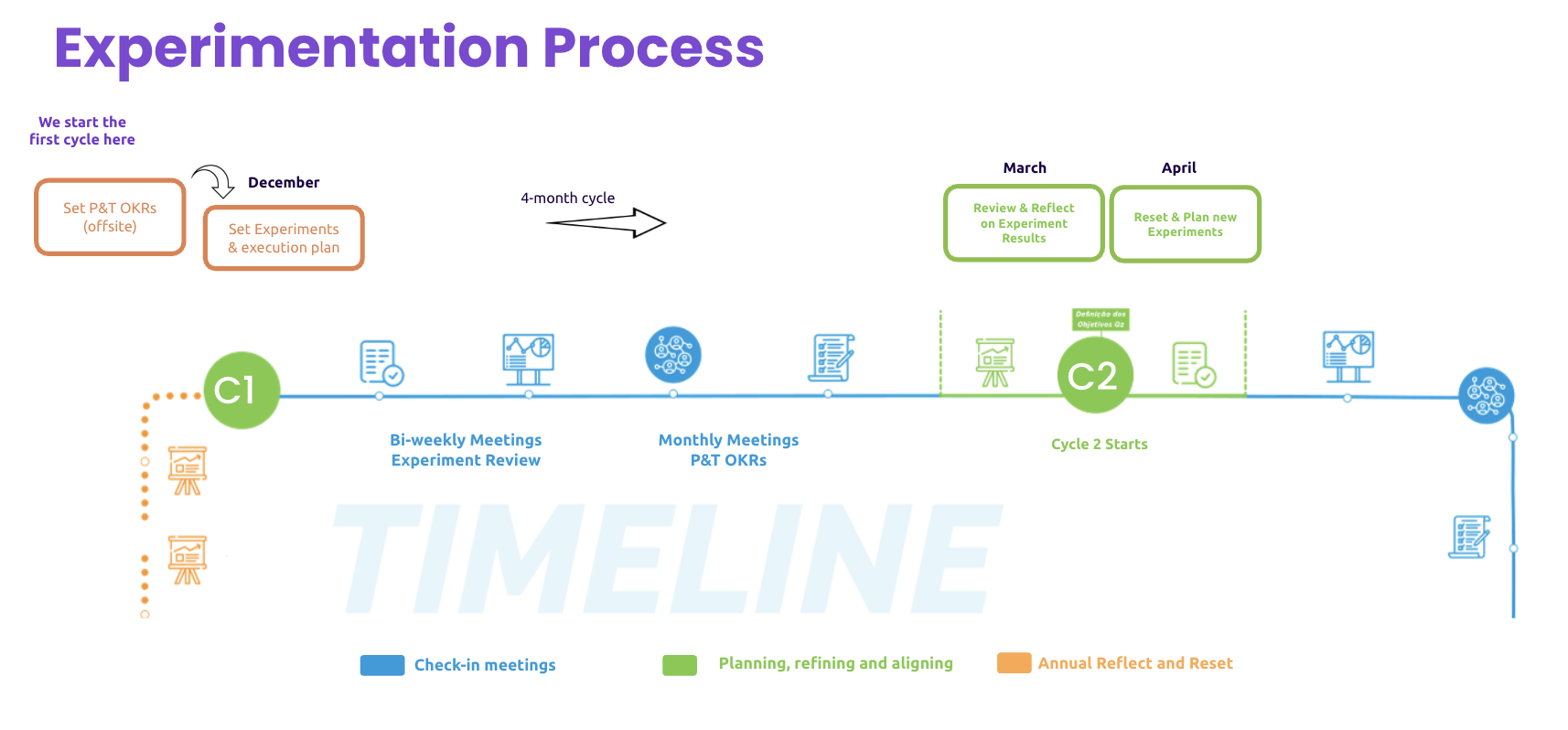
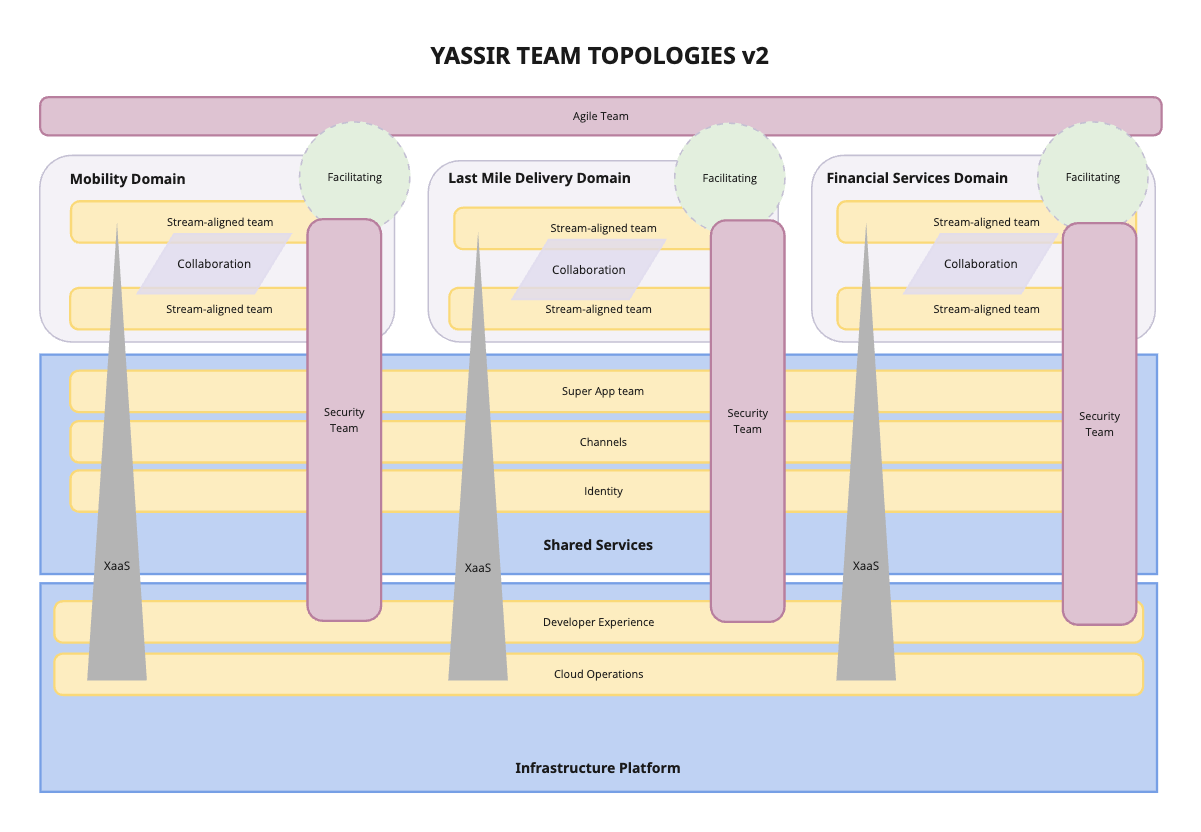
In 2023, Yassir adopted an evolutionary approach to organizational structure, building on the Team Topologies foundation. Through multiple iterations, each following a four-month cycle of testing, measuring impact, and learning, they introduced five key changes:
The Super App team evolved from mostly an integration team into a stream-aligned team focused on business metrics: customer acquisition and lifetime value, and upselling.
Created a new “Shared Services” domain as a centralized platform for common services like authentication and communication.
Moved QA engineers directly into stream-aligned teams, making quality an integrated responsibility rather than an external function.
Introduced a “Product Quality Specialist” enabling team to provide expertise on testing and risk mitigation practices.
Added an engineering enabling team to support architecture modernization efforts.
Revamped the release process to accommodate a multi-team mobile delivery model.
“Our evolutionary approach allowed us to iterate on our team structure as we learned,” explains a Yassir leader. “Rather than trying to design the perfect organization upfront, we made incremental improvements based on real-world feedback and measurements.”
Results: Remarkable Improvements in Performance and Satisfaction
Since embracing Team Topologies, Yassir has seen remarkable improvements across multiple dimensions:
140% increase in deployment frequency.
30% fewer incidents.
80% decrease in mean time to recovery.
70% decrease in our mobile app crash rate.
230% increase in employee satisfaction.
These impressive metrics reflect profound organizational improvements. In just three years, Yassir has seen its customer base grow from 3 million to 8 million users, expanded from 50 engineers to 400 across 30 countries, and secured almost $150 million in funding.
Ongoing Journey: Continuing to Evolve
Yassir’s journey with Team Topologies continues to evolve, with recent initiatives including:
Splitting the super app team into a stream-aligned team and a platform team that provides reusable tools to address common app integration issues.
Strengthening platform groups around AI services for product recommendation and fraud detection, to further reduce cognitive load on stream-aligned teams.
Adding a security enabling team for infra, application, and corporate security.
Creating new value-stream aligned teams as the business continues to expand.
Shifting towards business platformization, a platform ecosystem where any stakeholder can build value on top. Inter-team and inter-org interactions are key here.
Key Takeaways: Lessons from Yassir’s Transformation
Team structure drives performance: Deliberately designing teams around value streams dramatically improved delivery speed and quality.
Evolutionary approach works best: Embracing an evolutionary approach to organizational change allowed Yassir to continuously adapt to shifting business needs.
Common language matters: Team Topologies provided a shared vocabulary that helped articulate both the pain points and the art of possible in organizational design.
Minimizing dependencies in a Super App architecture: Ensuring that mobile teams with multiple dependencies can deliver efficiently and on time.
Platform and enabling teams reduce cognitive load: Streamlining workflows and upskilling stream-aligned teams allowed them to focus on delivering customer value.
As one Yassir leader summarizes: “Team Topologies provided us with guiding principles, best practices, and a common language for team design and collaboration. By embracing this approach, we’ve accelerated delivery times, improved product quality, and fostered stronger team cohesion and morale—all while scaling our organization at an unprecedented rate.”
Next steps: applying Team Topologies at scale
Request a keynote talk to inspire your teams and kickstart a transformation initiative
Order 50 or more copies Team Topologies Second Edition now in bulk - with free worldwide shipping
Buy an Enterprise Content License with access to a huge library of official Team Topologies workshop and training materials to catalyse large-scale transformation
Get an online consultation on Team Topologies with one of the co-authors of the book
About the author:

Ismail Chaib, Fractional CxO | Investor
Strategic technology executive with 17+ years of experience scaling high-growth startups and engineering organizations across EMEA, with a proven track record of leading complex tech initiatives from Seed to Series B+ and beyond. I am passionate about building and scaling high-performing tech teams, designing modular architectures, and leveraging the AI value chain, from data labeling and engineering to fine-tuning LLMs, deploying machine learning algorithms, and integrating autonomous AI agents to create transformative, real-world business value. At Yassir, Africa’s leading SuperApp with 12M+ users, I led the Product & Engineering department, growing the team from 40 to 300+ tech professionals across 30 countries in just three years. I built the company’s AI capabilities from the ground up, architecting and deploying end-to-end solutions spanning intelligent dispatching, dynamic pricing, fraud detection, route optimization, and personalized recommendations.