Curated content from Team Topologies authors and practitioners
Regular editions with the latest ideas, new tools, expert insights, upcoming events (conferences, meetups). In short, everything to be successful with applying Team Topologies.
We feature:
Insightful talks from experts applying Team Topologies in combination with other concepts (Domain-Driven Design, Agile, DevOps, Flow.
Case studies of organisations applying Team Topologies at scale.
Blogs and content sharing experience and elevating the application of Team Topologies in combination with other concepts and ideas.
Introducing experts and practitioners.
News, insights, new tools, events - everything about Team Topologies
From the archives…
"We're moving to a product operating model." If you've heard this announcement in your organization recently, you're not alone. The shift from project-based delivery to product thinking represents one of the most significant organizational transformations in modern business. But here's what many leaders don't realize: simply renaming project managers to product managers won't get you there.

For organizations facing critical structural bottlenecks or striving for radical business agility, the solution requires fundamentally reshaping how teams are organized around value delivery, managing both the complexity and the cognitive load placed on people. The core question must shift from, "Are we doing Agile right?" to, "Are we organized in a way that supports flow?".

The second edition of Team Topologies is now available. Six years after the original publication sparked a fundamental shift in how organizations approach structure and purpose, this updated edition provides the evolved framework leaders need to navigate today's complex landscape.

Agile gave us better delivery practices, but many teams still struggle with invisible friction. The real bottleneck isn't your ceremonies-it's whether your org structure actually supports fast flow.
Rich Allen's final piece in the 'Why Agile Isn't Enough' series explores how outdated team boundaries and coordination overhead quietly slow delivery, and why treating structure as a design lever (not a fixed artifact) can unlock the flow your teams are capable of.

In this 2nd part of the newsletter series ‘Why Agile isn’t enough (and what’s really slowing you down), Rich Allen explores two less visible frictions, overloaded platform teams and overly collaborative operating models, that quietly slow delivery. Instead of more process, we may need better questions about how our teams are structured, how they interact, and whether we’ve designed the organisation for clarity, autonomy, and flow.
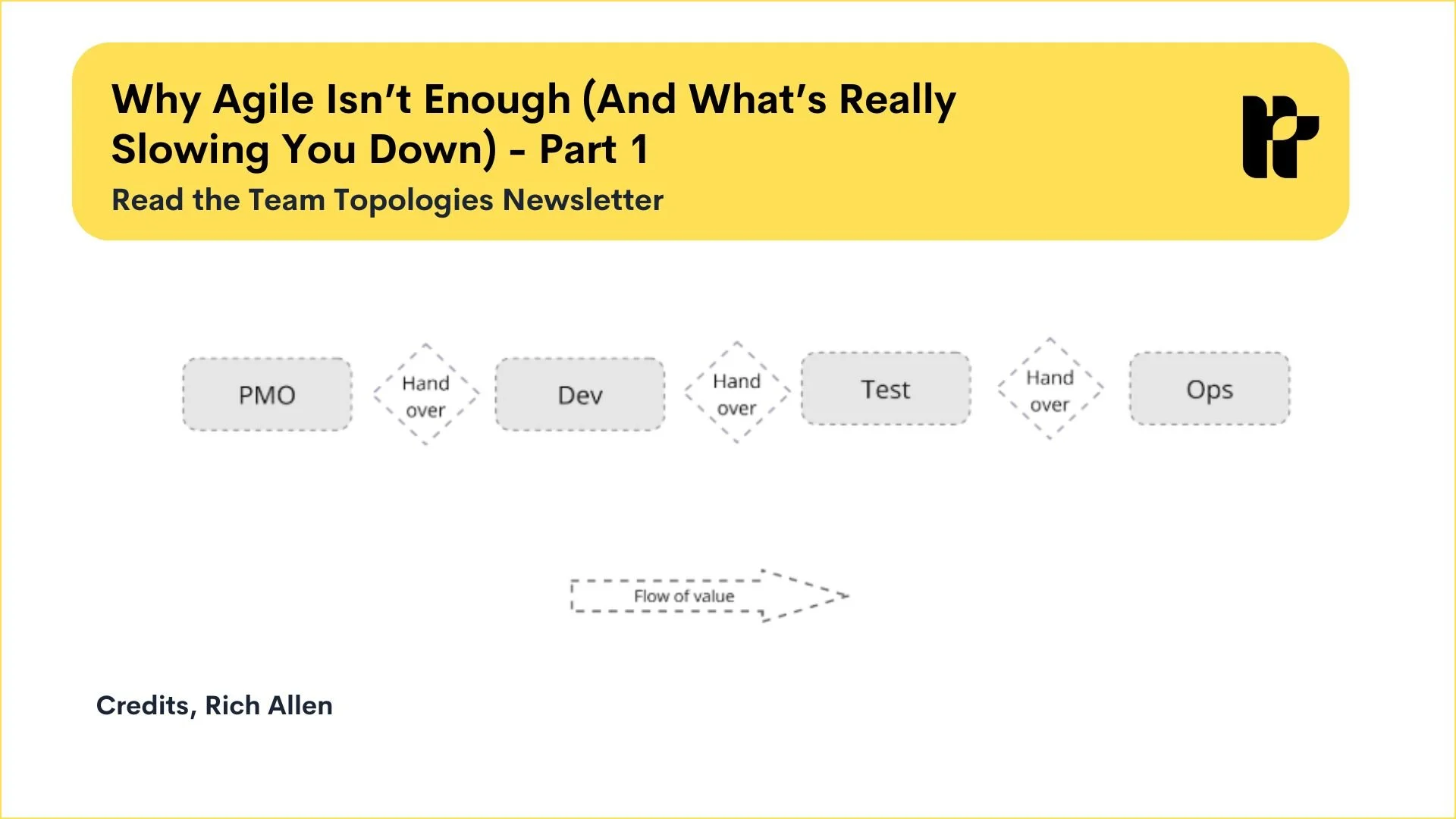
Many teams adopt Agile in the hope of moving faster. They introduce sprints and stand-ups, visualise the work, and improve discipline at the team level. The process brings rhythm, visibility, and a sense of progress, and yet, delivery is still slow. Work gets done, but the value takes too long to reach users. Dependencies multiply, coordination becomes a constant effort, and every step forward seems to rely on waiting for someone else. "We're doing Agile", but are we really being agile?
For many organisations, introducing Agile helps make the work more visible. Teams are more aligned in how they plan, estimate, and reflect. But visibility doesn’t equal flow, and progress on the board doesn’t always mean progress in the system. You can have well-run teams, but still struggle to deliver value end-to-end. At some point, you have to ask where the work is getting stuck, and why, what slows things down between teams, not just within them, and how are team structures within the organisation shaping the way value flows.

Is your team suffering from size-related cognitive overload? Team Topologies offers practical solutions.

In today's rapidly evolving business landscape, organizations face constant pressure to adapt and transform. Traditional hierarchical structures often prove inadequate in fostering agility and driving meaningful change. To address this challenge, leaders are increasingly exploring innovative approaches to team organization and collaboration. One such approach is leveraging the principles of Team Topologies, specifically the enabling team type and Facilitation mode.
Leadership teams do not see themselves as enabling team types. They often see the potential of enabling teams, but the default approach is to delegate the tasks to other teams, either by assembling new temporary enabling teams or asking a current team to behave as an enabling team to help other teams.
We have seen various types of enabling teams depending on the missing capability identified. Like agile coaches, SREs, testing specialists, you name it. Yet, we consider that leadership teams are in a unique position to behave as enabling teams to drive meaningful change in key strategic areas.

The true power of Team Topologies emerges not in academic discussion but in its practical application across diverse organizational contexts. In this newsletter series, we bring together the voices of several practitioners from the CNCF Platforms Working Group who have implemented Team Topologies principles in their organizations. Through their experiences—ranging from Bryan Ross' restaurant analogy for platform teams to Matt Menzenski's connection with Deep Work philosophy—a comprehensive picture emerges of how Team Topologies transforms organizational effectiveness by focusing on team cognitive load, clear interaction patterns, and service-oriented platforms. These complementary perspectives demonstrate that whether you're restructuring platform teams, mapping team interactions, or connecting individual and organizational productivity, Team Topologies provides a cohesive framework for driving meaningful improvement in how technology organizations deliver value.

As organizations, we want to minimize inter-team dependencies. However, there are specific moments where strategic temporary interactions are essential to help teams learn faster and more effectively from each other to address capability gaps and other blockers to flow.. In this issue, we will explore the facilitating interaction mode, which can support such situations.

The X-as-a-Service (XaaS) interaction mode from Team Topologies offers a fundamental pattern to help organizations avoid the trap of creating unnecessary “blocking dependencies” between their teams. This is essential to support organizations to scale while achieving a fast flow of value.

Discover how modeling team interactions correctly can transform your organization. By optimizing collaboration, teams can adapt faster, tackle challenges more effectively, and drive greater success. Learn how structured collaboration helps unlock agility, improve flow, and ensure your teams work at their best—fueling growth and innovation. This is part of our ongoing series to help you build high-performing teams and achieve organizational excellence.
This edition was curated by Eduardo da Silva

Many companies are looking at Team Topologies when trying to improve organizational efficiency and delivery speed. However, the three fundamental interaction modes - Collaboration, X-as-a-Service, and Facilitating - are often overlooked, misunderstood and misapplied, leading to decreased effectiveness and increased organizational friction rather than the intended benefits.
This edition was curated by Eduardo da Silva

Debunking common myths about organizational design! Discover how effective team structures drive sustainable success & innovation. Read the newsletter, subscribe to get more and let us know if we have missed anything.
Kudos to Brian Graham for this edition.

What challenges have you faced with team dynamics or flow in your organization? Kudos to Brian Graham for this edition.
Ever felt like team names, smart hires, or platform setups weren’t solving the real problems? There’s more to unlocking fast flow and innovation than meets the eye. Let’s dive into the hidden opportunities together!

Curious about transitioning from project-based work to a Product Operating Model? Our latest newsletter dives into how Team Topologies can help leaders navigate the unique challenges of this shift, especially in complex enterprise environments. We explore why internal platforms need to be treated as products and discuss the complexities of defining product boundaries in ways that empower teams. Discover insights on structuring value streams for multi-team products and building effective 'team-of-teams' architectures.

Curious about transitioning from project-based work to a Product Operating Model? Our latest newsletter dives into how Team Topologies can help leaders navigate the unique challenges of this shift, especially in complex enterprise environments. We explore why internal platforms need to be treated as products and discuss the complexities of defining product boundaries in ways that empower teams. Discover insights on structuring value streams for multi-team products and building effective 'team-of-teams' architectures.

Organizations that adopt a "platform as a product" approach can fundamentally transform and accelerate the value realization from their digital product development. With the move to Product Operating Models, aka Project-to-Product transitions, more and more leaders realize the importance of sound platform engineering strategy and approach.

In the five years since Team Topologies was published, the framework has become a go-to tool for leaders looking to streamline their organizations. The book’s core concepts—stream-aligned teams, managing cognitive load, and clear interaction modes—have been widely adopted across industries, from startups to large enterprises. Case studies show that while the framework provides structure, it's flexible enough to adapt as teams and their needs evolve. Companies have particularly benefited from the emphasis on reducing cognitive load, which has helped improve delivery speed and team efficiency.

Transitioning from a project-based approach to a product-driven mindset can significantly enhance how organizations deliver value and meet customer expectations. Unlike projects, which have a defined end date, products are continuously evolving and require adaptability to meet changing market needs. That ability for products - and thus teams - to quickly respond and adapt, requires an environment which is supportive of change. Many organizations today are restricted in that area, because of their structure and decision making processes.

Independent Service Heuristics(ISH) are a set of simple questions that help have discussions and design discussions for creating modular, autonomous, and efficient teams within an organization. As Matthew Skelton and Manuel Pais, the authors of Team Topologies, explain, these heuristics guide the structuring of services to optimize team performance and service maintainability.

Independent Service Heuristics(ISH) are a set of simple questions that help have discussions and design discussions for creating modular, autonomous, and efficient teams within an organization. As Matthew Skelton and Manuel Pais, the authors of Team Topologies, explain, these heuristics guide the structuring of services to optimize team performance and service maintainability.

Flow is essential for an effective and high-performing organization. Matthew Skelton and Manuel Pais, authors of Team Topologies, emphasize that understanding and managing flow blockers can significantly enhance team effectiveness and productivity. Let's explore common blockers to flow and resources to help mitigate these challenges. Learn why it is important to address them , how to tackle them and what strategies are available for you and your team.

Cognitive load is a central tenet of Team Topologies principles and practices.that Matthew Skelton and Manuel Pais developed. As Martin Fowler explains, "Much of Team Topologies is based on the notion of Cognitive Load." While in previous issues of the newsletter we have focused on the relationship between cognitive load and platform groupings, we haven’t looked deeper into these concepts and how they are crucial to enable a fast flow of change in the organization.