Evolving an empowered, high-performing delivery ecosystem using Team Topologies at REA Group

Authors: Nicole Devine, Executive General Manager for Product and Technology for Financial Services at REA Group, Nerine Erasmus, Senior Technical Program Manager at REA Group, Alison Rosewarne, Executive Manager of Architecture and Tech Learning and Development at REA Group, and Alex Stokes, Director and Co-Founder of ReBoot Co.
Interviewed by Matthew Skelton, co-author of Team Topologies.
Key takeaways
The implementation of Team Topologies within REA Group's Financial Services business unit resulted in several profound and measurable business outcomes across flow, quality, employee well-being, and customer satisfaction.
The flow efficiency percentage doubled since the launch of Team Topologies, indicating significantly faster and more sustainable delivery of work.
The team engagement score in the Financial Services business unit rose to 94%, a figure considered exceptional and "almost unheard of globally". This was attributed to constant communication, empowerment, and the proactive management of cognitive load.
Quality Assurance (QA) practices saw an increase in first-time right delivery from 80% to 88%.
Teams reduced in size from up to 25 people to ~4–8 people, were explicitly empowered to own their domains and make decisions independently, leading to faster movement and greater accountability.
Reduced overburden and time sinks saving over 75 hours per person per quarter.
Teams gained a deeper understanding of the business model and how their work contributed directly to revenue generation and the key objectives.
In 2023, REA Group, Australia's leading digital property business, faced challenges within its Financial Services business unit, primarily concerning slow delivery speed, widespread delivery blockages, and cognitive overload among its large, monolithic product and technology teams. In response, starting in February 2024, the Financial Services department at REA Group adopted the principles and patterns of Team Topologies (TT), moving beyond viewing the organization as an "efficient machine" toward a "flourishing, humane ecosystem". The implementation specifically focused on reducing complexity, reducing team sizes drastically, and enhancing flow discipline through intentional ways of working.
The organizational shift was highly successful, built upon a critical precondition: REA Group's excellent culture that empowers teams to thrive and deliver. This culture, characterized by high maturity in delivery practices, allowed leaders to trust teams with significant decision-making capabilities. Key success metrics demonstrate this impact: Financial Services achieved a doubling of flow efficiency, reduced time sinks by saving over 75 hours per person per quarter, and fostered an engaged workforce, evidenced by a team engagement score of 94%—a score considered almost unheard of globally. Furthermore, the improved focus and delivery quality resulted in an increase in positive customer sentiment (broker engagement) of 15%.
The need for fast flow of value at REA Group
REA Group operates Australia's leading residential and commercial property portals, including realestate.com.au and realcommercial.com.au. The organization, which started in a garage 30 years ago, is considered one of Australia's great technology success stories, having grown into a top ASX-listed business. REA Group’s purpose is to "change the way the world experiences property". Beyond property listings, REA has expanded into ancillary businesses such as financial services, focusing on bringing property and finance together to address the challenge of affordability in the Australian property market. REA also leverages its data assets through PropTrack, its property data business, to create unique insights and valuation models.

The Team Topologies transformation initially focused on the Financial Services business unit. This unit employs approximately 400 people in head office, managing mortgage broking networks, and serving approximately 840 franchises and 1,100 brokers nationally. Within this business unit, the Product and Technology department comprised 104 people at the time of the change. Broadly, REA Group operates across five to six major business units, comprising a large number of similarly sized teams across the organisation. The success achieved in Financial Services has created an ambition within the organization to replicate the approach across the rest of REA Group.
Initial challenges: slow delivery, delivery blockers, and cognitive overload
Before adopting Team Topologies, the Financial Services technology department experienced challenges that hampered its ability to deliver value quickly and sustainably.
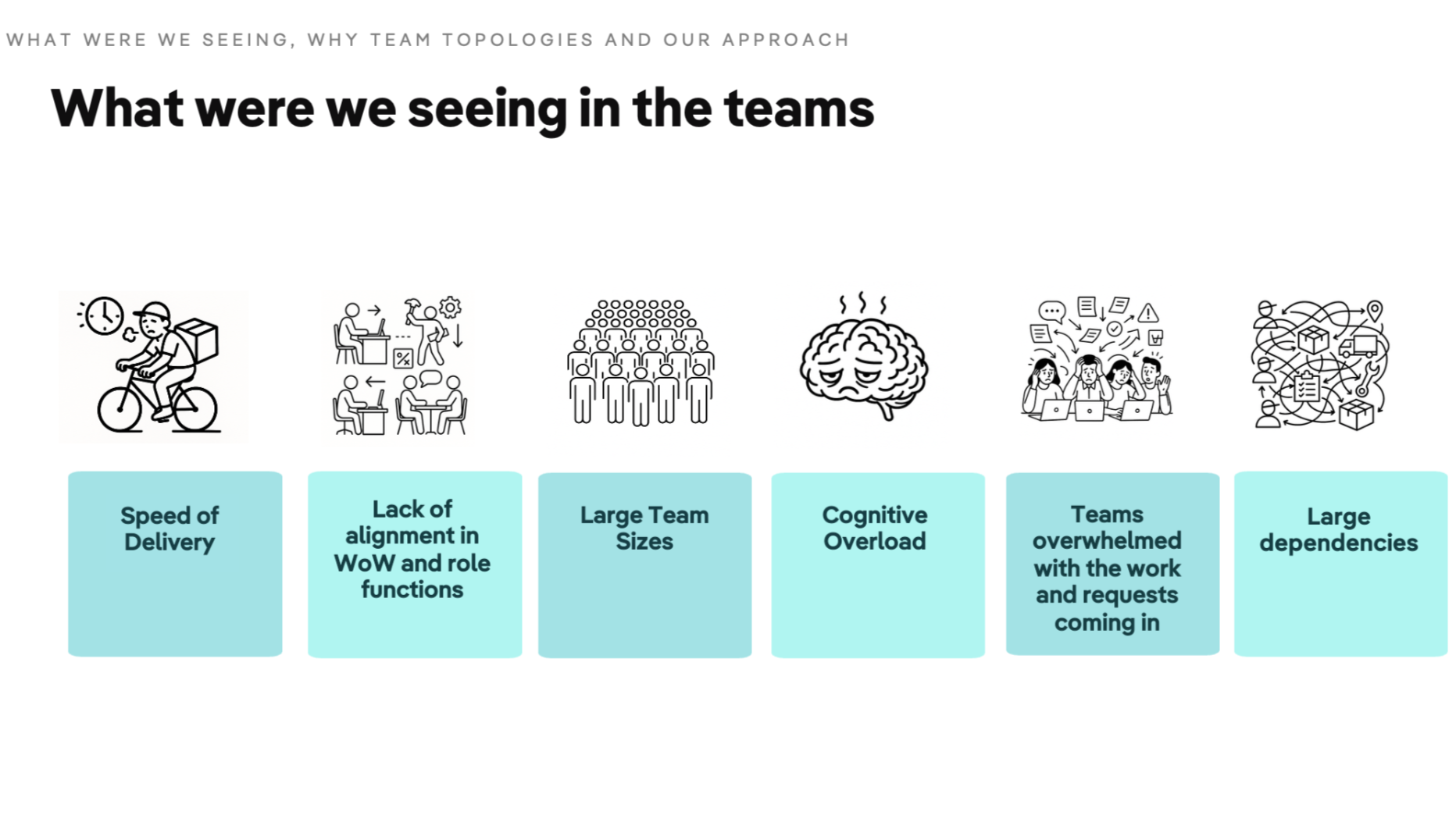
One of the foremost challenges was the lack of speed and blockages in delivery. Although the unit felt it had sufficient staffing, the delivery process was protracted, resulting in some stakeholders (both internal and external) becoming impatient for value and quality solutions.
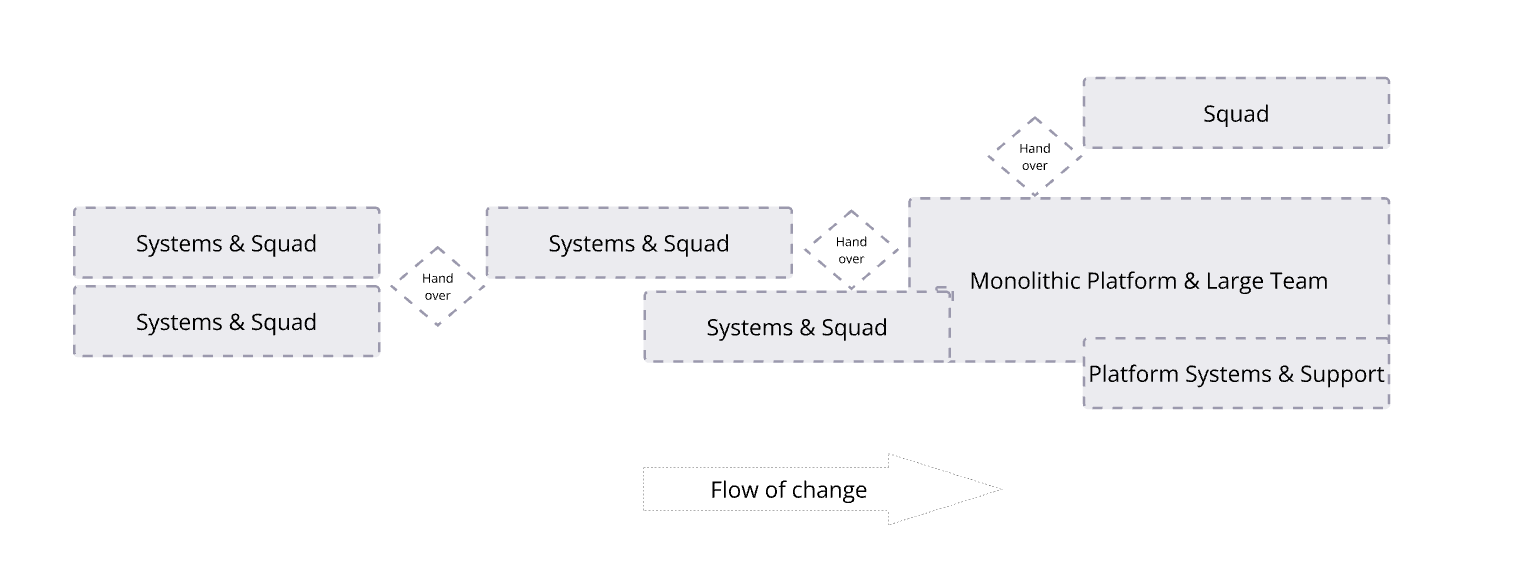
Structurally, the teams were organized along monolithic platforms, which led directly to the creation of large, monolithic teams. The core platform was managed by a team size of about 25 people, while other squads typically had 10 to 15 members. These large team sizes made decision-making difficult and slow, while also driving high cognitive load as teams were required to manage many responsibilities, dependencies and contexts at once.
At times, teams became overwhelmed, stemming from a continuous flow of work from multiple different stakeholders, coupled with continuous Business As Usual (BAU) support tickets following two years of integration. This led to a state of cognitive overload. Team Topologies emphasizes that when teams are overwhelmed, quality declines, innovation stalls, and risks escalate. Technology staff immediately recognized and looked forward to a solution.
Finally, the department experienced a lack of alignment in ways of working, including differing approaches to sprints and varying tooling across product and technology groups - reducing visibility, slowing decision making and limiting confidence in delivery health across the department.
Aims: more rapid value delivery via increased autonomy and empowerment
The leadership aimed to deliver faster and address persistent delivery blockages to better meet broker and customer expectations, while keeping pace with business demands.
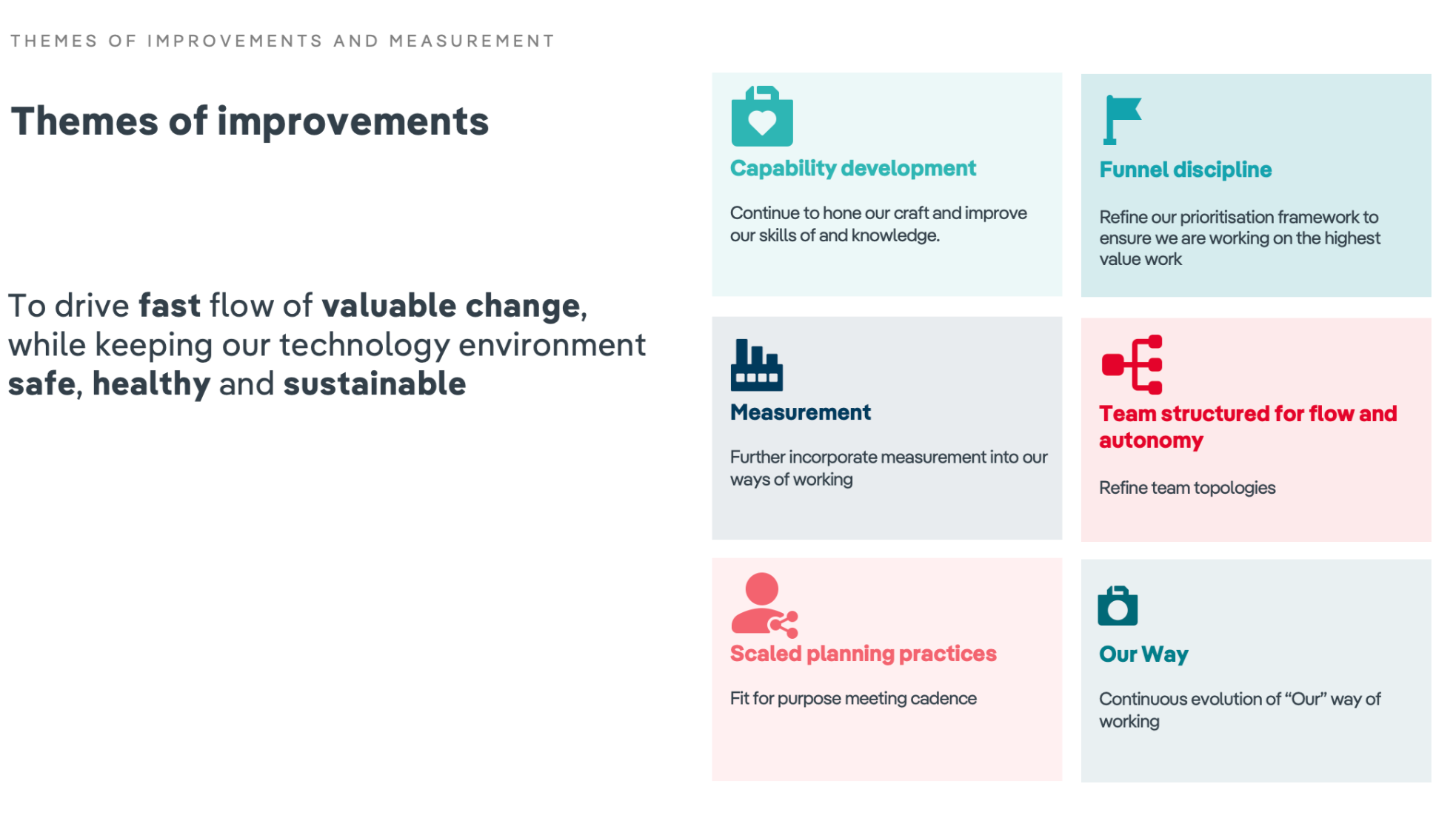
A central goal, informed by the TT approach, was to address the cognitive load. Team Topologies identifies cognitive load as a fundamental design principle that must be optimized for effective work systems. By reducing the load, the department aimed to allow teams to focus deeply on their specific domains, leading to deeper expertise and superior outcomes.
The department specifically sought to achieve fast flow of value and move towards sustainable delivery. They needed to move away from a culture where teams felt compelled to say "yes" to requests coming in from multiple stakeholders, external sources and channels. The visual of a large pipe blocked in the middle, rather than a thin, sustainable flow, crystallized the problem they were trying to solve.
Structurally, the aim was to reduce the size of teams significantly to improve accountability and ownership. The target was to move from teams of up to 25 people to small, autonomous squads typically comprising four to eight people (maximum nine), including no more than six engineers. This reduction was intended to push decision-making authority down to the squad level, increasing autonomy and speed. They also sought to achieve clearer alignment of work to the underlying business outcomes, which the value stream alignment piece helped articulate.
Transformation catalyzed by external consulting expertise
The transformation was spearheaded by an external consultancy (ReBoot Co.) that introduced Team Topologies as a "guidebook" for managing the complex, system-wide change. Led by Alexandra Stokes, author of Empowered Agile Transformation, ReBoot played a vital role working with the senior leadership team to catalyse the changes in the Financial Services department at REA Group.
Phase 1: Alignment and Education
The first step involved taking all engineering teams, product managers, and designers through foundational training to align everyone on a common language, the proposed operating model, and the thinking behind the change. This repetition of core concepts—anchoring on the value driver and purpose—was essential for setting the department up for success.
Phase 2: Value Stream Mapping and Structure
The Financial Services department utilized the Lean concept of organizing around value streams. Due to the linear nature of their business (lead generation on the portal through to loan settlement and revenue capture), defining the value chain was relatively straightforward. Mapping this out created "light bulb" moments for people, helping them understand their contribution to how REA earns revenue and assists Australians in acquiring property.
They then applied the Independent Service Heuristics approach (invented and championed by the authors of Team Topologies) to map domain and service boundaries, which required an iterative process of workshops and refinement. The resulting structure utilized many stream-aligned teams. Team sizes were reduced, adhering to the guidance that teams should be small (no more than nine people). This transition, though requiring change management, was crucial for empowering teams.
Phase 3: Empowering Autonomy and Intentional Flow
A core component of the implementation was trust and empowerment. Leaders intentionally pushed decision-making functions down to the engineers and product managers, effectively removing the traditional need to go through long hierarchies for approval. The established, high-maturity culture at REA Group facilitated this trust.
To address unnecessary work and time sinks, the Financial Services department made the bold decision to ban PowerPoint decks for reporting and cancelled numerous non-essential meetings. This move was coupled with the introduction of intentional meetings and a shift to a single source of truth. The teams aligned on JIRA and Jira Product Discovery, as well as aligned sprint cycles and shared ways of moving work through boards. This created immediate transparency, allowing leaders (including executive management) to access live, current information directly. The continuous visibility of the data acts as a forcing function, ensuring the information remains current. Work is now prioritized based on value percentage and estimation, ensuring the highest value work flows through the system first.
Key ideas from Team Topologies: cognitive load, fast flow, team size limits, and intentionality
The Team Topologies approach provided a powerful and practical blueprint for shaping a dynamic, adaptable operating model.
1. Cognitive Load as a Design Principle: Team Topologies was the first approach that explicitly identified cognitive overload as a design principle. The book’s focus on centering human mental load in organizational design resonated deeply, providing a label and a mechanism to solve overwhelm. By optimizing cognitive load, REA was able to achieve deeper expertise and superior outcomes.
2. Organizing for Fast Flow: The fundamental focus on the flow of actual value to customers via incremental delivery guided the entire transformation. This emphasis allowed REA to define and structure its teams based on the logical, linear flow of mortgage brokering, resulting in highly effective stream-aligned teams.
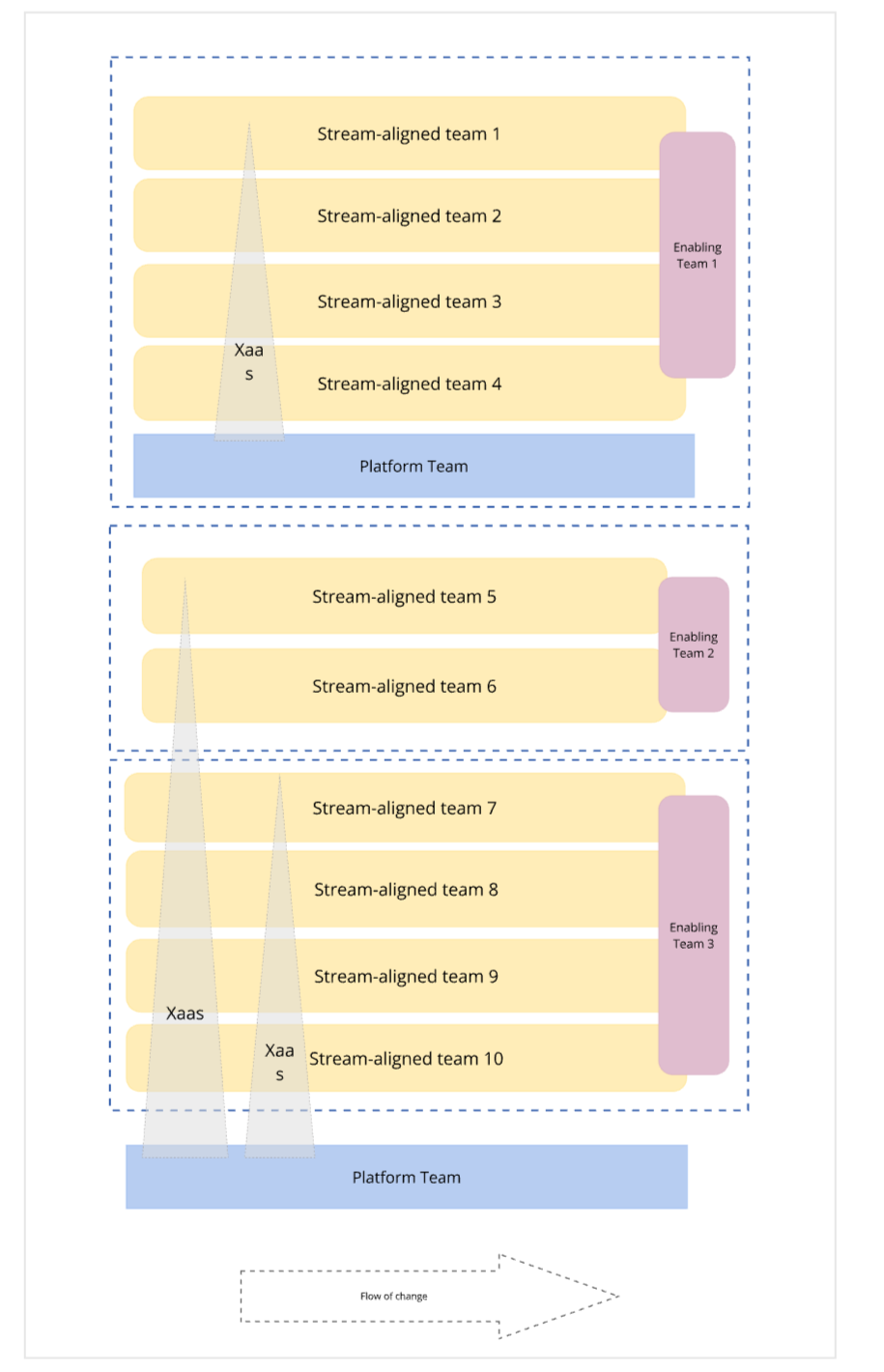
3. Team Size Heuristics: The book provided the authority and common language to enforce the shift to small teams. Having the principle articulated that teams should be around nine people maximum was incredibly useful in challenging internal desires to continue adding more people to existing squads. The shift to small teams improved accountability and ownership.
4. Reverse Conway Maneuver: This concept was instrumental in convincing leadership and teams that the challenge of their monolithic platform was directly caused by the size and structure of their teams. Applying Team Topologies enabled the organization to break up the monolithic platform responsibilities by re-defining team boundaries; this is an important step in the re-architecture of the platforms.
5. Focus on Intentionality: Team Topologies encourage increasing teams’ agency and fostering higher trust levels. This principle supported REA Group’s drive to make delivery and management practices highly intentional—focusing not just on removing meetings, but ensuring necessary meetings were targeted and prepared.
Challenges overcome: change resistance and elevated efforts to align
While the principles of Team Topologies were generally well-received and effective, the implementation faced challenges typical of any major structural change:
Resistance to Change: Change is inherently fraught, leading to feelings of fear or the "fight or flight" response among staff. Recognising this as a risk, the team proactively planned mitigation activities, including broad education, alignment on common language, and ongoing reinforcement of the “why”.
Challenges of Transition: A key piece of feedback received after the rollout was that even after careful planning and consideration there was a desire to have even more time dedicated to knowledge sharing and transition. This is a challenging scenario and also why change is hard when there is specialist knowledge existing in silos.
Brave and Bold Decisions: Making the spaghetti of dependencies "non-spaghetti" required leadership to be "brave and bold" in setting guiding principles. Although this was successful, the process was initially difficult because dependencies still existed even after the teams were restructured.
The Always-On Conversation: Organizational design is an ever-evolving martial art, not a destination or a short-term program. Post-launch, the department continues to iterate on team structure, team member alignment, capabilities, and system custodianship to ensure the structure always reflects the balanced needs of the market, customer or internal teams.
Outcomes: enhancements to customer sentiment, staff engagement, flow efficiency, software quality
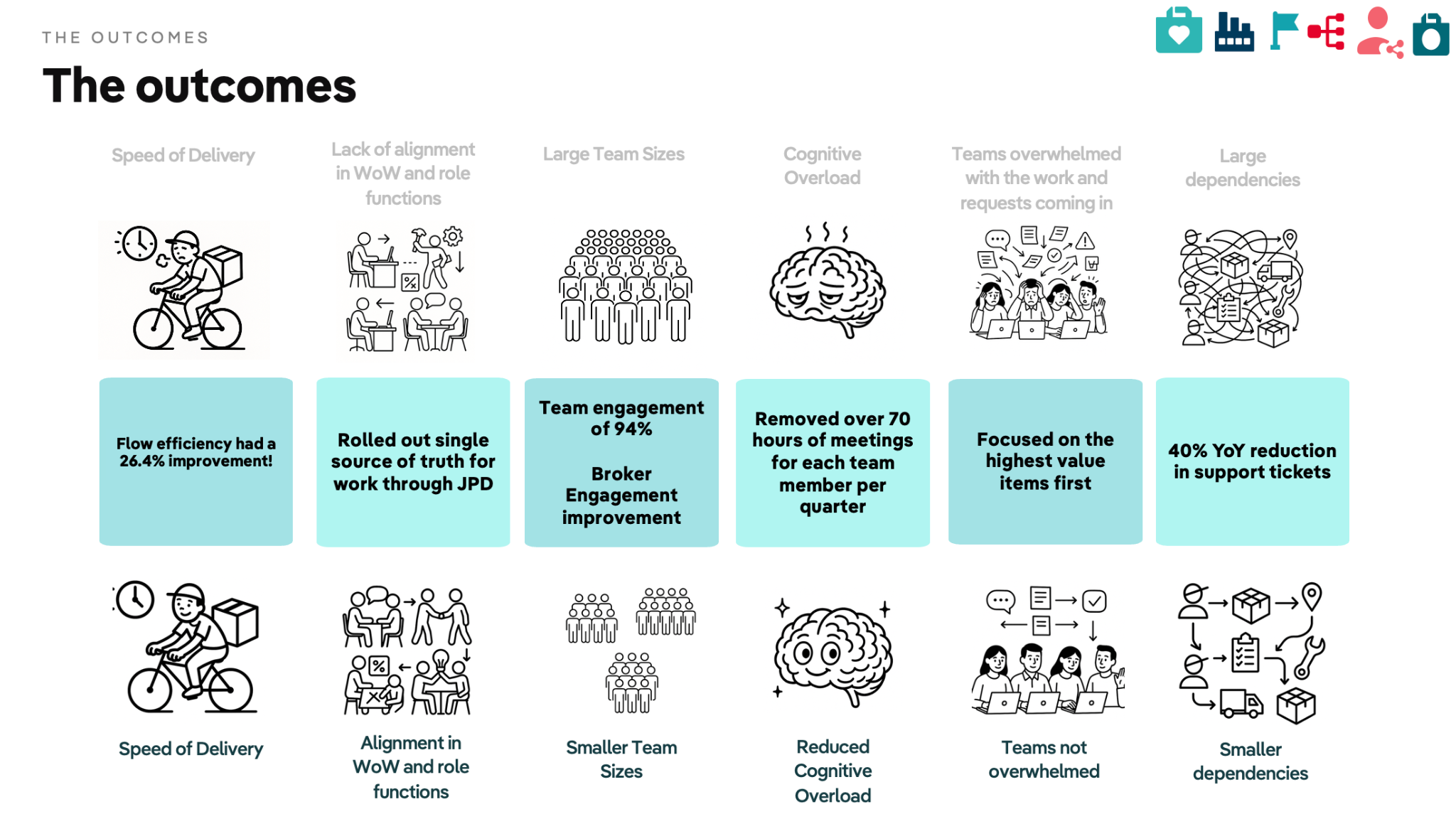
The adoption of Team Topologies principles within REA Group’s Financial Services unit yielded profound positive impacts across efficiency, employee well-being, and customer outcomes compared to 12 months previously.
Flow and Efficiency Gains
The focus on intentional flow and value alignment resulted in dramatic performance improvements:
Flow Efficiency Doubled: Since the launch of Team Topologies, the measured flow efficiency percentage has doubled YoY.
Reduction in Time Sinks: By removing the requirement for updating and presenting metrics via PowerPoint decks, the department saved over 75 hours per person per quarter, which equates to more than ten full working days.
Improved Quality: QA practices saw an increase in first-time right delivery from 80% to 88%.
Transparency and Single Source of Truth: Implementing a self-service model based on real-time JIRA and Jira Product Discovery data meant that information was no longer locked away or hoarded. This provided the leadership team with direct, accurate insights and served as an "unlock for everyone" to make informed decisions.
Flow Efficiency was chosen as a key metric because it's a measure of how long work items spend waiting in "queues". By improving flow efficiency, work spends less time in queues, allowing work to move to value realisation quicker.
Enhanced Team Well-being and Autonomy
The proactive management of cognitive load and the emphasis on empowerment led to exceptional employee outcomes:
Record Engagement Score: The team engagement score in the most recent assessment was 94%. This score is considered virtually unheard of globally.
Increased Autonomy: The reduction of team size (from 25 people down to ~4–8) and the explicit granting of "permission" to make decisions and suggest changes empowered teams to be more autonomous, move faster, and feel greater ownership.
Strategic Focus: By delegating decision-making to the squads, senior leaders were freed up for more strategic thinking.
Business and Customer Outcomes
The improvements in flow and quality translated directly into business value:
Increased Customer Sentiment: Broker engagement, a key measure of positive customer sentiment, increased by 15%.
Value Delivery: Teams are now consistently delivering value to consumers more often and with higher quality, prioritizing work based on a created value model.
These successes highlight that Team Topologies is not just an approach for reorganization but an evolutionary approach that facilitates shaping organizations characterized by sustained agility, innovation, and well-being. The achievement was underpinned by REA Group’s existing high-trust environment, proving that an excellent culture is highly beneficial for the successful adoption of TT concepts.
Next steps: applying Team Topologies at scale
Request a keynote talk to inspire your teams and kickstart a transformation initiative
Order 50 or more copies Team Topologies Second Edition now in bulk - with free worldwide shipping
Buy an Enterprise Content License with access to a huge library of official Team Topologies workshop and training materials to catalyse large-scale transformation
Get an online consultation on Team Topologies with one of the co-authors of the book
About the authors:

Nicole Devine, Executive General Manager for Product and Technology for Financial Services at REA Group

Nerine Erasmus, Senior Technical Program Manager at REA Group

Alison Rosewarne, Executive Manager of Architecture and Tech Learning and Development at REA Group,

Alex Stokes, Director and Co-Founder of ReBoot Co and Team Topologies Advocate