Newsletter ( March 2026): From Projects to Products - Why the Transition Needs Team Topologies - PART 1

LEARN | APPLY | SCALE - Executive essentials
Learn: "How To Scale Without Slowing Down: A Guide To Economies Of Empowerment", by Matthew Skelton (Article)
Apply: Book a keynote for your next leadership offsite. Inspire your executive team with proven patterns and principles (Keynotes, by the authors of Team Topologies)
Scale: Everything you need to roll out Team Topologies organization-wide (ETP)
This is part 1 of a 3-part newsletter series on "Product Operating Models".
"We are moving to a product operating model."
If you've heard this announcement in your organization recently, you're not alone. The shift from project-based delivery to product thinking represents one of the most significant organizational transformations in modern business. But here's what many leaders don't realize: simply renaming project managers to product managers won't get you there.
In a recent conversation with product expert Melissa Perri on the Product Thinking Podcast, Matthew Skelton explored why this transition requires far more than new job titles—and how Team Topologies provides the organizational design language to make product operating models actually work.
The mindset chasm between projects and products
The difference between project and product thinking runs deep. Projects assume that once you've finished a package of work, there are no ongoing effects from how you chose to execute it. Check the box, move on, done.
Products demand something entirely different: holistic thinking about user experience, coherent value packaging, and continuous evolution. A product mindset requires understanding that every decision you make today shapes your ability to adapt tomorrow.
This isn't a subtle distinction—it's a fundamental shift in how organizations think about value delivery. And most organizations dramatically underestimate the cultural transformation required.
The question that changes everything
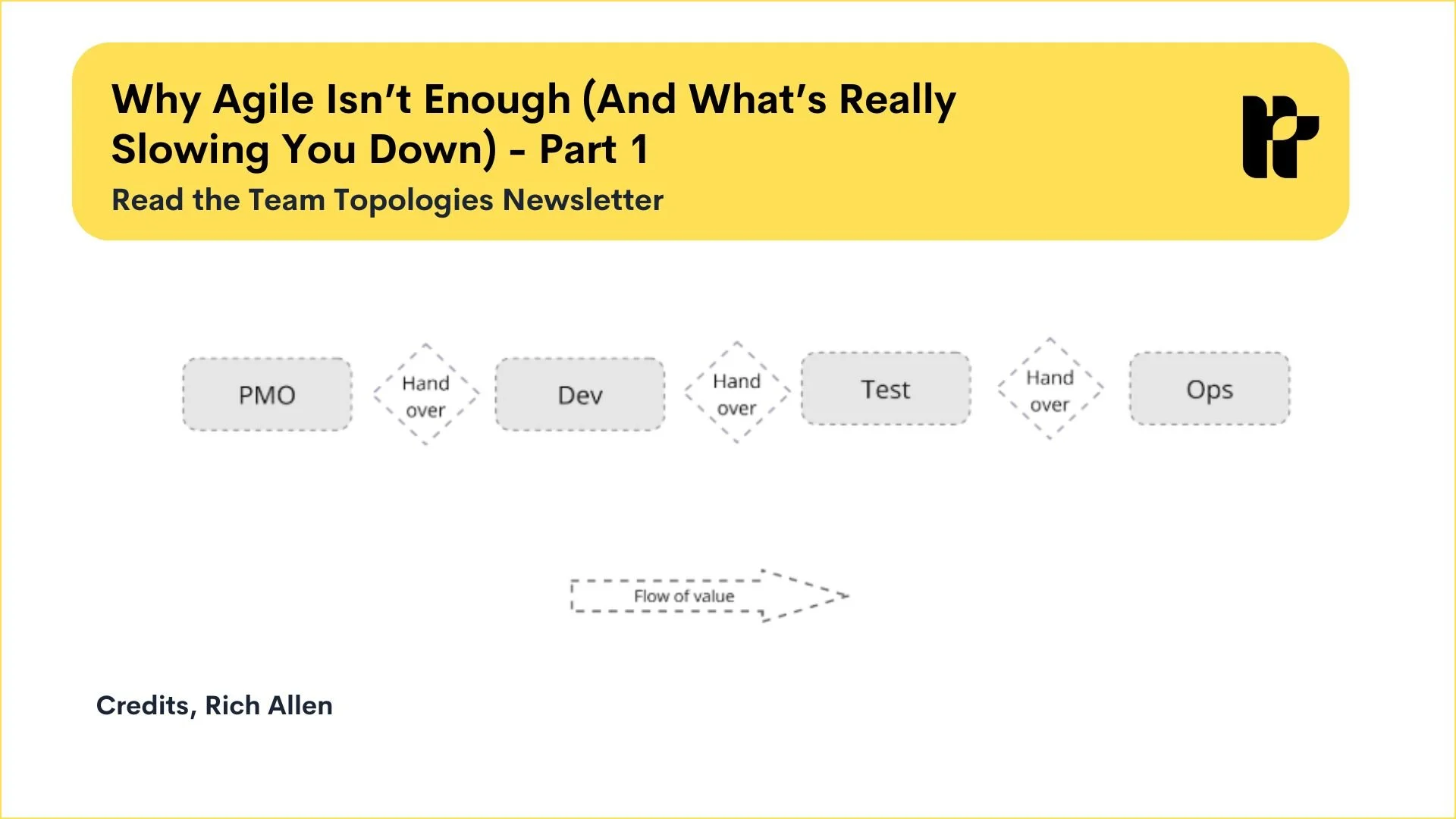
Team Topologies starts with a deceptively simple question: What does it take to have no handoffs in the flow of value?
This question drives everything else. When you eliminate handoffs, you need:
Long-lived teams with mixed skills and capabilities
Deep domain context maintained over time (both technological and business)
True end-to-end ownership of value streams
Teams that can make decisions safely without constant external dependencies
You can't build teams that simply pass work from development to testing to deployment. That's the old project model with new labels. Instead, teams must own the entire value stream from understanding user needs through delivery and ongoing operation.
As Matthew Skelton notes during his discussion with Melissa Perri: "For you and me, it's obvious, but turns out for lots of people, it's a very different way of doing things." (Excerpt from Product Thinking Podcast, Ep. 211)
Why organizations underestimate the investment
The first major pitfall: underestimating the effort and time required. Organizations often think they can rename roles, run a few training sessions, and declare victory.
This fails because the mindset shift touches everything: funding models must change from project budgets to continuous product investment; success metrics must evolve from "on time, on budget" to "value delivered to users"; decision-making authority must shift from project steering committees to empowered product teams.
The good news? This investment pays off. Organizations that successfully make this transition report faster time-to-market, better customer outcomes, and significantly higher employee engagement.
The hidden complexity of "value"
Team Topologies exposes something uncomfortable: a lack of clarity about mission and purpose. When you try to align teams to the flow of value, you immediately face the question: what is the value?
Many organizations realize they haven't defined this clearly. They've been working in terms of projects, features, and outputs—not customer value and outcomes. As Matthew observed, "It's like they're on the psychologist's couch, like, tell me about yourself. What value do you provide? And it's actually quite awkward for some organizations." (Excerpt from Product Thinking Podcast, Ep. 211)
Transform your operating model
Moving from projects to products? It's more than a reorganization—it's a fundamental shift in how teams work, decisions get made, and value flows.
Manuel Pais and Matthew Skelton have guided hundreds of organizations through this exact transition.
Book their keynote "Moving to the Product Operating Model with Team Topologies".
Welcome Team Topologies advocates
We are proud to have new Team Topologies Advocates:
If you're passionate about Team Topologies and want to become an advocate, we would love to have you join us. Or, if you have a story to share, we would be happy to feature it on the website.
What's next in this series
In our next newsletter, we'll dive deeper into the four Team Topologies team types and explore why many readers miss the crucial concepts by stopping too early in the book.
Resources: Explore the full conversation between Matthew Skelton and Melissa Perri: Product Thinking Podcast, Episode 211.