Groupings
One of the most crucial clarifications in the second edition addresses a common misunderstanding: a platform is a grouping of teams, not necessarily a single team. In organisations with more than 40 to 50 people, an internal platform typically requires more than one 8-person team to provide the necessary services, hence the introduction of the term "platform grouping". This means that while a "Platform team" might refer to a single team working within a platform, it more often denotes a collection of multiple teams operating within this grouping.
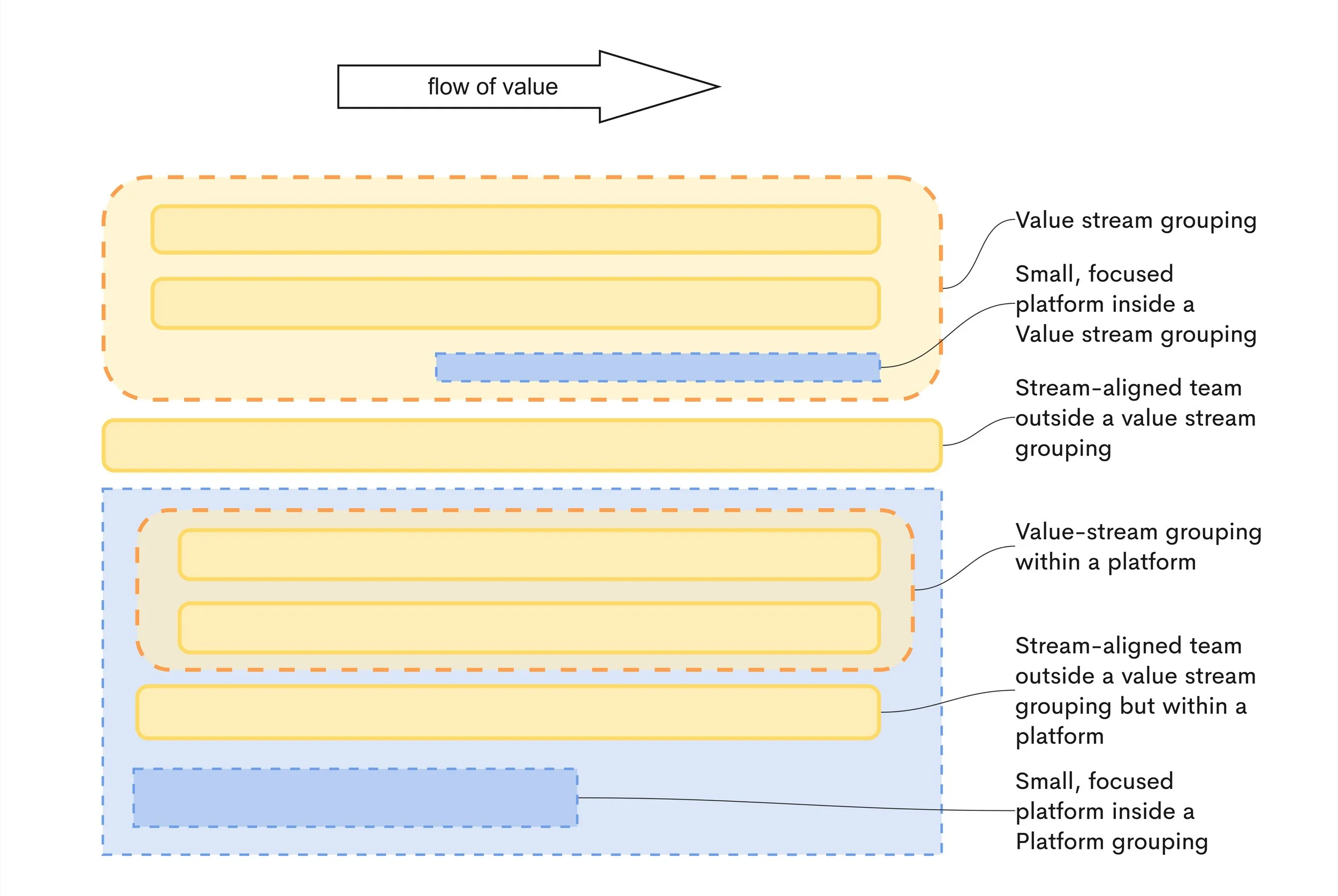
A platform is usually a grouping of other teams around a common purpose. Likewise, there are often groupings of Stream-aligned teams around a common value stream.
This refined understanding highlights the fractal nature of organisations, where self-similar patterns exist at multiple "zoom levels". A mature platform approach needs to be both fractal and dynamic, evolving as business needs and strategy change. Examples like Adidas's digital platform, which is a logical, high-level grouping of multiple platforms and services (each with dedicated teams, rather than a single monolith), perfectly illustrate this concept. Similarly, NAV, the Norwegian Labour and Welfare Administration, has implemented a small number of coherent internal platforms (application, data, and design system) instead of a cumbersome single platform. This model allows for flexibility while keeping cognitive load manageable for consuming teams. The second edition also introduces the concept of a "value stream grouping," generalising this multi-team approach to broader value delivery.
Discover more ideas from Team Topologies Second Edition