Combining Team Topologies and Better Value Sooner Safer Happier for effective value delivery
By Jon Smart and Matthew Skelton
Photo by Nothing Ahead from Pexels: https://www.pexels.com/photo/hands-forming-a-heart-shape-14111878/
As organizations strive to adapt to a rapidly changing world, many find themselves struggling with outdated structures and mindsets. Team Topologies (TT) and Better Value Sooner Safer Happier (BVSSH) offer a powerful, complementary approach to solving these modern challenges. At their core, TT and BVSSH share a remarkably aligned mission: both are dedicated to making the world of work more humane and more effective for everyone. By embracing emergence, empowering human dynamics, and focusing on sensing over commanding, businesses can fundamentally transform their operating models.
The operating context of the modern enterprise
To understand why TT and BVSSH are so critical today, we must first look at the operating context of the modern enterprise. Over the last few centuries, starting with the first Industrial Revolution in 1771, organizations have primarily optimized their structures for repetitive, knowable work. This was the era of the factory system, mass production, and extreme division of labor, where humans were treated merely as cogs in a machine. In the first Ford factory, for instance, employees spoke over 50 different languages, but it did not matter because they did not need to collaborate; they simply executed highly specialized, repetitive tasks like building a wheel day in and day out. Within the Cynefin framework, this type of work sits in the complicated or clear domains, characterized by known unknowns and predictable outcomes.
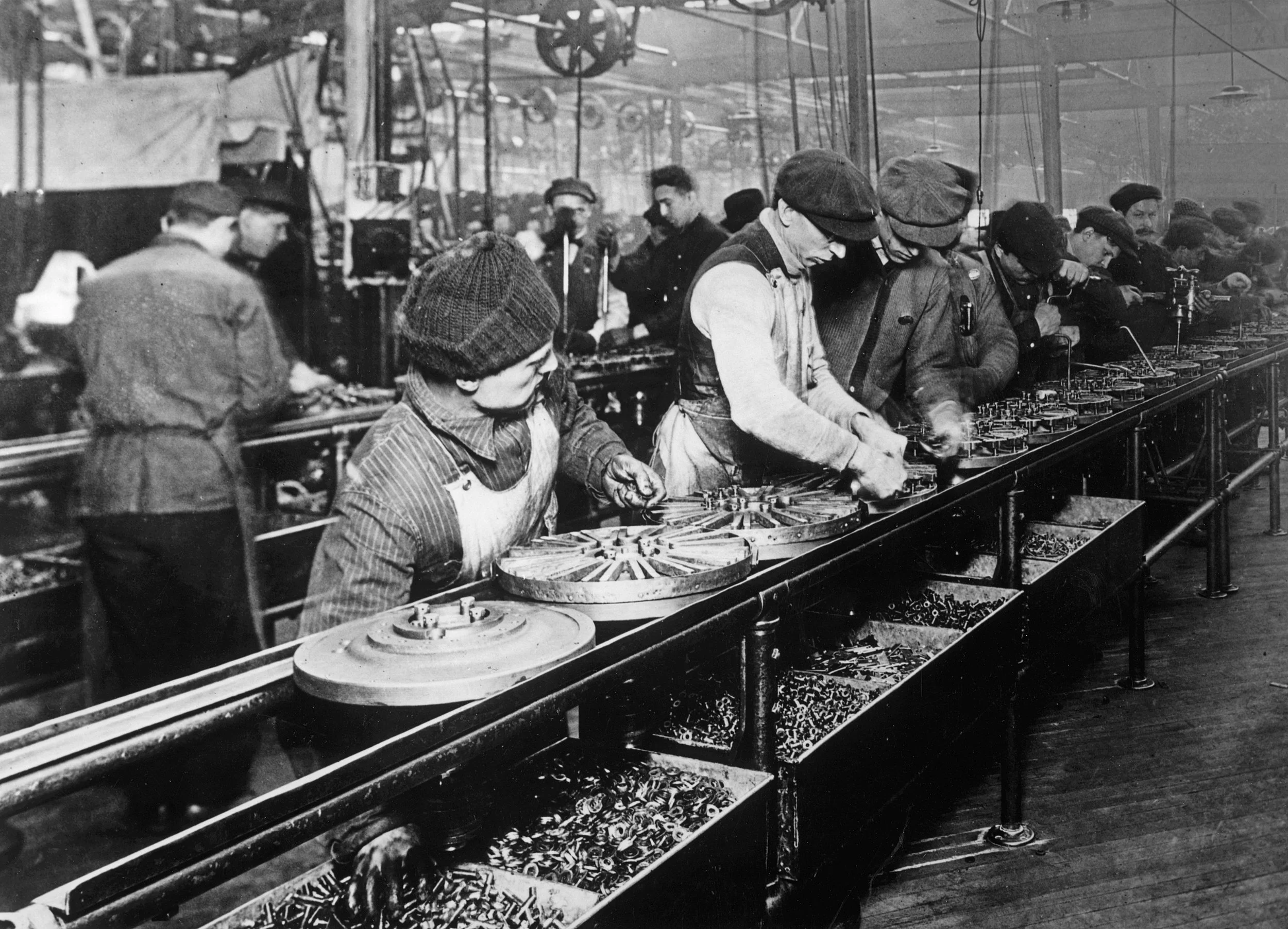
By Unknown author - file:Ford_assembly_line_-_1913.jpg, Public Domain, https://commons.wikimedia.org/w/index.php?curid=173264685
Photo by Walls.io from Pexels: https://www.pexels.com/photo/colleagues-standing-by-whiteboard-17724731/
However, we have now transitioned out of the age of oil and mass production and into the age of digital. In this new era, the domain of work has radically changed. Physical and repetitive tasks are increasingly automated by computers and robots, leaving humans to handle work that is fundamentally unique and unknowable. In knowledge work—such as applying for a loan or booking a flight—the routine processes are entirely automated, meaning the primary job of humans is to innovate, handle change, and continuously improve the system.
Because the future is unknowable and the work is complex, organizations can no longer rely on silos; they must optimize for intense cross-functional collaboration and long-lived flows of value. Every organization is perfectly designed to get the results it currently gets. If a modern enterprise wants to thrive, it must deliberately pivot away from output-driven factory models and optimize for this new, unknowable domain of work.
Understanding TT and BVSSH: principles and patterns
Instead of rigid playbooks, TT and BVSSH provide adaptable philosophies for this complex environment. Team Topologies is not a prescriptive framework, but rather a set of enabling constraints designed to encourage emergent behavior for fast flow. It utilizes four team types, three team interaction modes, and fundamental concepts like minimizing team cognitive load and building the "thinnest viable platform" to empower teams to adjust their own boundaries.
Better Value Sooner Safer Happier, on the other hand, is a collection of context-agnostic principles, patterns, and anti-patterns for business agility. It recognizes that every organization is a unique, complex adaptive system. Therefore, it focuses on providing a "tailwind" through proven patterns that make the hard job of behavioral change slightly less hard, while identifying anti-patterns that create unnecessary "headwinds".
Combining forces for better outcomes
When TT and BVSSH are used together, they provide a comprehensive operating model that helps enterprises avoid major pitfalls and achieve superior outcomes. Their combined use can be categorized into five major patterns:
1. Focus on Outcomes, Not Outputs: Implementations should never be about adopting "agile for the sake of agile" or blindly creating tribes and squads. Organizations must articulate a unique "why" that appeals to multiple personas and translates into measurable outcomes. The BVSSH outcomes are Better Quality, Unique Value, Sooner time to value (optimizing for lead time and flow efficiency), Safer continuous compliance (agile, not fragile), and Happier colleagues, customers, citizens, and climate. TT helps design the team structures necessary to actually deliver these specific outcomes.
2. Pilot and Iterate: A massive anti-pattern in organizational design is the "wall of water"—a top-down, big-bang reorganization that leaves no room for learning. Humans have a limited velocity to unlearn and relearn, and you cannot force the pace of change across tens of thousands of people at once. The combined pattern is to think big, start small, and learn fast. Organizations must treat change as a multi-year, continuous journey where they pilot new team topologies with early adopters, learn from the data, and iterate.
3. Involve Over Inflict: Avoid the anti-pattern of mandating structural changes and job titles from the top down, which creates job insecurity and destroys psychological safety. Instead, organizations must invite and inspire participation. By using group insights from the people actively doing the work, leadership can better sense where team boundaries should naturally sit based on data flow and customer challenges.
4. Minimize Coupling: Many organizations resemble a chaotic "Rube Goldberg machine," plagued by extreme complexity and frantic dependency management. While visualizing these dependencies is helpful, it is not enough. The complementary TT and BVSSH pattern is to break dependencies rather than just manage them. Organizations must strive for high cohesion (having one job and doing it well) and low coupling, utilizing TT interaction modes to alleviate the biggest bottlenecks to the flow of value.
5. Evolve Boundaries Continuously: There is no such thing as a perfect organizational design or a static set of value streams. If you attempt to design the perfect structure up front, you will get it wrong. Teams must expect to get boundaries wrong initially and establish data feedback loops to sense and respond over time. Structural evolution must be continuous, adjusting to shifts in the internal and external environment.

Real-world success stories
Numerous organizations across diverse sectors are actively combining these two approaches to remarkable effect.
John Deere: Over the last four to five years, John Deere has successfully scaled these concepts. They apply TT's team types and platform principles while relentlessly focusing on the BVSSH metrics of quality, value, time to value, safety, and happiness as their ultimate measures of success.
Saxo Bank: This financial institution is actively leveraging the enabling constraints of Team Topologies in tandem with the patterns and principles of BVSSH to guide their agile architecture.
The Pensions Regulator: This UK government department utilized user needs mapping to discover effective TT team boundaries for their internal platforms, while relying on BVSSH anti-patterns to identify and navigate operational challenges.
US Air Force Program Office: In a highly rigid military environment, TT provided a desperately needed common language for civilians, military personnel, and contractors. They paired this with BVSSH practices, utilizing OKRs to focus on outcomes and treating anti-patterns as vital guideposts to avoid.
Alef Education: Operating in the Middle East, Alef explicitly treats team cognitive load as a key design principle for their architecture. They use TT to reduce dependencies while focusing on BVSSH principles regarding team health, compliance, and OKR-driven outcomes.
KPMG Switzerland: Moving away from top-down mandates, KPMG uses TT platform and product practices to organize into business-aligned portfolios. BVSSH principles sit at the core of their strategy, ensuring change is driven from the ground up by communities.
Adevinta: This advertising company built internal platforms using TT concepts to enhance flow and reduce cognitive load. Inspired by BVSSH, they created internal tooling to track flow efficiency and assess team happiness.
Ultimately, the combination of Team Topologies and Better Value Sooner Safer Happier is about rejecting the inhumane, mechanical management styles of the past. By optimizing for human empathy, continuous learning, and intelligent team boundaries, modern enterprises can build systems where high performance and human happiness go hand in hand.
Watch the webinar with Jon Smart and Matthew Skelton
View the slides
About the authors:

Jon Smart, Business Agility expert and lead author of ‘Sooner, Safer, Happier’
Jon is co-founder and CEO of SSH. Jon is a business agility practitioner, thought leader, and coach. Jon has been an agile and lean practitioner since the early 1990s. Jon helps large organisations deliver better value sooner, safer and happier through better ways of working. He is the lead author of the award winning and bestselling 'Sooner Safer Happier: Patterns and Antipatterns for Business Agility'.

Matthew Skelton, Exec Advisory | Operating Models | Capability Design
Matthew Skelton is one of the foremost leaders in modern organizational dynamics for fast flow of value, drawing on Team Topologies, Adapt Together™, and related practices to support organizations with transformation towards a sustainable fast flow of value and true business agility.
Co-author of the award-winning and ground-breaking book Team Topologies, Founder and CEO/CTO at Conflux, and director of core operations at Team Topologies, Matthew brings a humane approach to organizational effectiveness.
Read more on Team Topologies