Accelerating Value Delivery: How Enabling Teams and the ETAP Dynamic Drive Scale
By Manuel Pais
Photo by Kampus Production from Pexels: https://www.pexels.com/photo/woman-in-black-tank-top-looking-at-a-man-lifting-a-bar-6922171/
“By using Enabling teams to upskill product teams and linking their insights to Platform innovation through the ETAP dynamic, engineering leaders can systematically reduce cognitive load, eliminate central bottlenecks, and empower teams to deliver fast flow at scale.”
In many organizations today where leaders are faced with demonstrating ROI from AI adoption, the overarching goal is achieving a fast flow of value to customers. Yet as architectures become more distributed and tech stacks grow increasingly complex, product teams - or stream-aligned teams, as Matthew Skelton and I refer to them in Team Topologies - frequently find themselves overwhelmed by excessive cognitive load.
To counter this, many organisations rush to build internal platforms. However, building a platform without first understanding team capabilities often leads to mismatched tools and underutilised infrastructure. This is where Enabling teams play a crucial role.
While a Platform team focuses on creating an internal product - providing self-service APIs, tools, and infrastructure that reduce cognitive load - an Enabling team functions like an internal consulting arm. Its primary mission is to bridge capability gaps, upskill stream-aligned teams, and foster autonomy without introducing permanent blocking dependencies.
The Core Pain Points Enabling Teams Are Designed to Solve
When organisations struggle with slow delivery, the root cause is rarely a lack of developer effort; it is almost always systemic friction. Enabling teams are specifically structured to target several persistent organizational pain points:
Cognitive Overload on Product Teams: Developers are often expected to master end-to-end delivery, infrastructure management, security compliance, observability, and UX design simultaneously. This excessive cognitive load diverts precious mental bandwidth away from solving core business problems.
Critical Skill and Capability Gaps: Whether adopting Site Reliability Engineering (SRE), test automation, advanced data science, or modern code review practices, stream-aligned teams frequently lack specialized expertise.
The Hidden Cost of Self-Guided Learning: A common misconception in IT is that engineers can seamlessly pick up new technologies in isolation. While teams can learn on their own, doing so without guidance introduces invisible costs, trade-offs, and architectural shortcuts that compromise long-term quality.
Centralised Functional Bottlenecks: Traditional central departments (e.g., a centralized QA, UX, or security department) often become gatekeepers. Stream-aligned teams end up waiting on these central teams to execute work for them, turning capability gaps into delivery blockers.
Platform Disconnection: Platform teams frequently build technical abstractions in isolation without a clear understanding of the real daily struggles of their internal customers.
By sending experts to pair directly with stream-aligned teams for defined periods, Enabling teams address these friction points at the source, helping product teams build capability rather than waiting for external execution.
Overcoming Challenges: The Funding and ROI Dilemma
Despite their clear benefits, establishing Enabling teams is notoriously challenging. The primary obstacle is funding and value visibility. Executive leadership can easily see the high cost of allocating senior specialists to Enabling roles, but they often struggle to measure the direct return on investment. Because an Enabling team’s success is reflected in the performance of other teams, leaders must often take a initial leap of faith.
Beyond funding, organisations frequently fall into additional traps:
The Dependency Trap: If an Enabling team acts as an outsourced execution arm—doing the work for the product team rather than teaching them how to do it—it creates a permanent dependency, undermining fast flow.
Capacity Burnout: Expert members of Enabling teams can easily get pulled into operational firefighting or platform support, fracturing their focus.
Attempting Big-Bang Training: Trying to teach an entire domain to a team all at once leads to knowledge overload. Enabling teams must instead focus on the smallest incremental step a team can absorb.
Scaling Organizational Capabilities Bundle (20% off)
Learn how to leverage Enabling Teams and activities to continuously address missing skills and capability gaps, and how to leverage Platforms to scale key organizational capabilities to achieve a sustainable flow of value creation.
How to Build Executive Buy-In for Enabling Teams
To overcome the funding barrier, I strongly advise organisations to start small. Rather than creating multiple dedicated Enabling teams immediately, ask existing experts to dedicate 20% to 30% of their time to structured enabling work. Demonstrating tangible improvements on the ground—such as helping a team independently manage error budgets or streamline code reviews—builds the internal trust necessary to justify dedicated funding.
Furthermore, organisations should distinguish between tactical, short-lived Enabling teams formed to solve a specific temporary capability gap (e.g., lasting three to six months) and strategic, structural Enabling teams that oversee long-term capability growth across the enterprise.
Real-World Examples: Enabling Teams in Practice
Several leading organisations demonstrate how Enabling teams accelerate value flow in practice:
Uswitch: The UK-based comparison service introduced a small, dedicated SRE Enabling team. Instead of taking over operations, this team works on the ground alongside product engineers, teaching them how to adopt SRE practices and manage error budgets autonomously. Crucially, they also act as ground sensors, gathering real-world feedback to inform platform development.
Capra Consulting: The Norwegian consultancy applied Team Topologies across its entire organization. In their model, executive leadership operates as a combined Platform and Enabling team, creating strategic artifacts (such as Miro strategy frameworks) to align independent teams without micromanaging execution.
Data Science Upskilling: In online retail environments, centralized data science departments often evolve into Enabling structures. Rather than building every machine learning model centrally, Enabling specialists partner with product teams to embed data science capabilities directly into domain applications.
The ETAP Dynamic: Linking Enabling Teams and Platform Innovation
Over the past few years, my co-author Matthew Skelton and I - together with TTVPs from the core group - have defined what we call the ETAP (Enabling Team and Platform) dynamic. ETAP represents the common pattern we see where an Enabling team “emerges” from a Platform to undertake some sensing and uplift work across the organization, before returning to the platform to implement new services, refinements, etc. ETAP is designed to prevent bottlenecks and gatekeeping, particularly when organizations face major technological shifts such as AI adoption and AI-first roles.
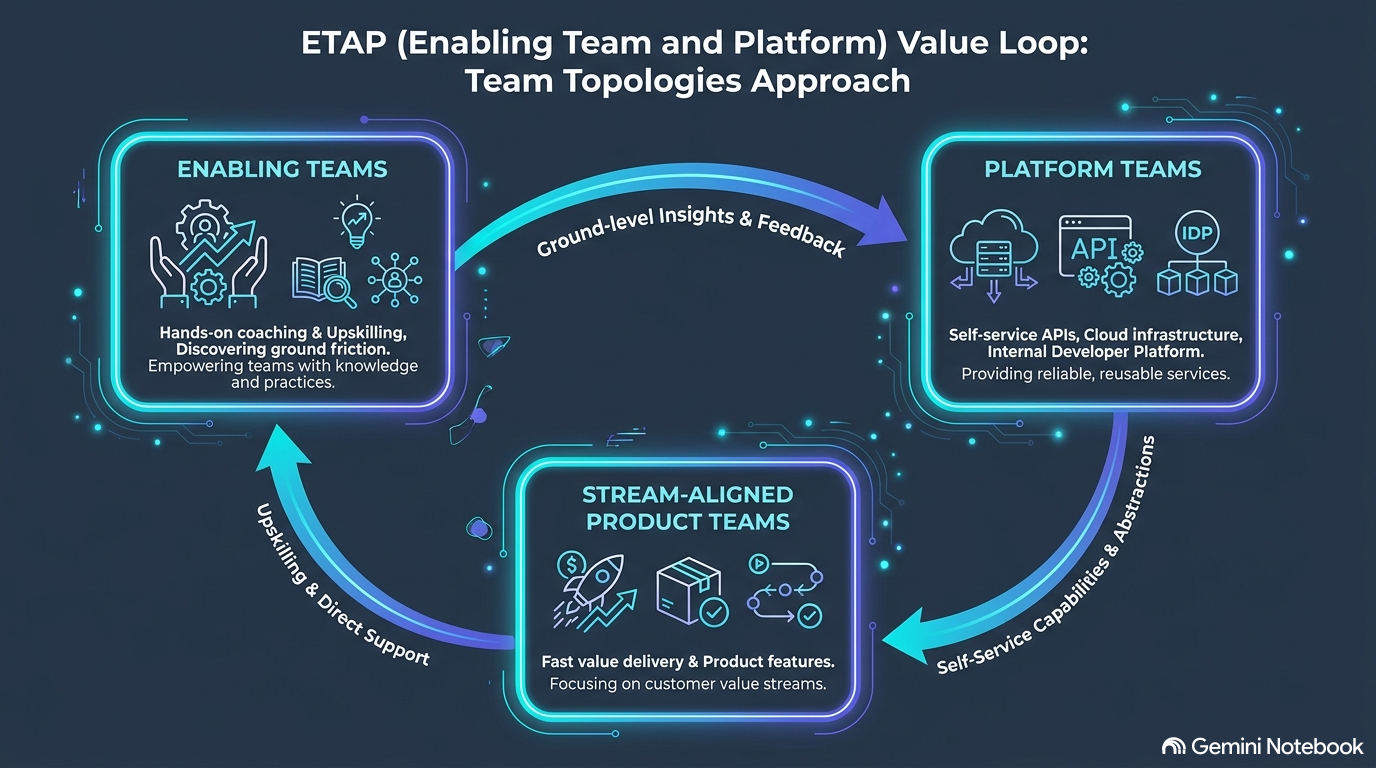
The ETAP dynamic operates as a continuous, symbiotic cycle:
Ground Sensing: Enabling teams work directly with stream-aligned teams, discovering unvarnished insights into operational friction, tool gaps, and usability hurdles.
Informing Platform Innovation: Rather than allowing every product team to invent bespoke workarounds, the Enabling team feeds these ground-level discoveries directly to Platform teams.
Productising Solutions: The Platform team uses this feedback to design, build, or refine self-service abstractions and standardized tooling that directly solve proven pain points.
Accelerating Adoption: The Enabling team returns to the stream-aligned teams to help them smoothly consume the newly updated platform services in small, digestible steps.
By linking regular Enabling activity to ongoing Platform innovation, organisations avoid building platforms in an ivory tower. This continuous feedback loop ensures platform investments target genuine friction, driving fast flow and sustainable success at scale.
Conclusion - use Enabling team to unlock value delivery
Accelerating value delivery is not simply about adding tools or mandating new frameworks; it requires deliberate organizational design. By using Enabling teams to upskill product teams and linking their insights to Platform innovation through the ETAP dynamic, engineering leaders can systematically reduce cognitive load, eliminate central bottlenecks, and empower teams to deliver fast flow at scale.
This article is based on the podcast interview with DX at https://getdx.com/podcast/team-topologies-platform-work/
About the author:

Manuel Pais, co-author of Team Topologies
Manuel is on a mission to both make work more humane and businesses more valuable to customers. Manuel delivers motivational keynotes and thought leadership on the principles and patterns for #fastflow that resonate across the organization, from C-level executives to the teams on the ground.
Manuel has trained thousands of industry leaders through his courses and workshops, and helped multiple organizations pave the path for fast flow via no-BS strategic & organizational assessments. Manuel is based in Madrid but calls Lisbon home.
Read more on Team Topologies